
Silver mercury
99.99% Pure Mercury Guide: Industrial Uses, Safety & Compliance
Aug
Learn about 99.99% pure mercury, industrial applications, purity verification, supplier due diligence, safety requirements, regulations, storage, and safer alternatives.
Complete Guide to 99.99% Purity Silver Liquid Mercury for Industrial Use
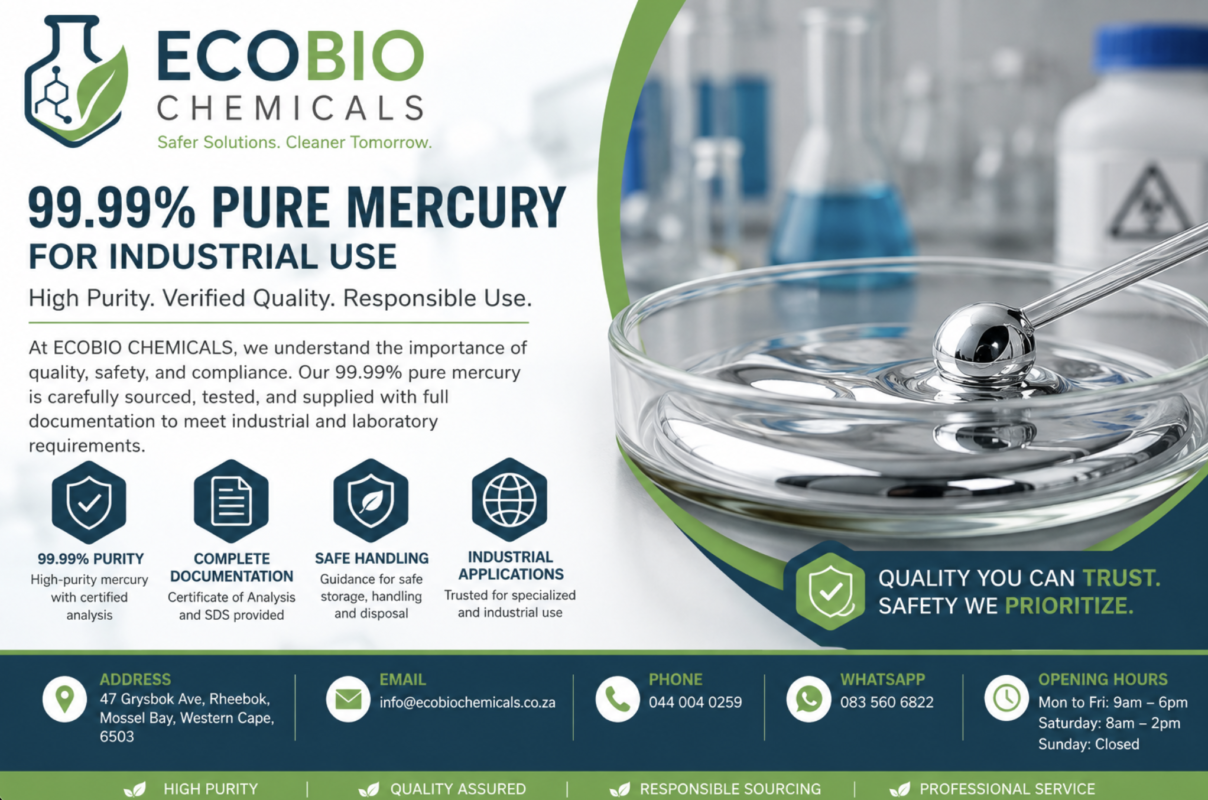
99.99% pure mercury is a specialized material associated with certain scientific, laboratory, measurement, and industrial applications. Because mercury is a highly toxic substance, organizations dealing with it must consider far more than chemical purity alone.
Companies looking to buy 99.99% pure mercury, or researching for silver liquid mercury suppliers or industrial grade mercury online should understand the technical specifications, documentation, legal requirements, workplace controls, transportation rules, and environmental responsibilities associated with mercury.
This guide explains the most important considerations for organizations evaluating high-purity mercury for legitimate industrial applications.
What Is 99.99% Pure Mercury?
99.99% pure mercury is mercury with a stated purity of approximately 99.99%, meaning that only a small fraction consists of other substances or impurities.
High-purity mercury has distinctive physical and chemical properties that have historically made it useful in specialized applications. However, the required specification depends on the particular process or equipment involved.
A percentage stated in a product listing should not automatically be treated as proof of quality. Industrial users should request appropriate technical documentation, including a Certificate of Analysis (CoA), batch identification, analytical information, and a current Safety Data Sheet (SDS).
Why Does Mercury Purity Matter? 99.99 pure Mercury
Purity can be important when a manufacturing or laboratory process requires tightly controlled material characteristics. Impurities may affect performance, measurements, chemical behavior, or equipment compatibility.
When evaluating 99.99% purity mercury, organizations should consider:
- Chemical purity
- Testing methodology
- Batch or lot number
- Certificate of Analysis
- Safety Data Sheet
- Packaging specifications
- Traceability
- Applicable industry standards
- Regulatory requirements
A professional procurement process should verify the specification rather than relying solely on marketing claims.
Industrial Applications of Mercury
Mercury has historically been associated with several specialized applications, although many uses have declined because of health and environmental concerns and the availability of alternatives.
Potential areas in which mercury has historically been encountered include specialized scientific equipment, certain measurement technologies, research applications, and legacy industrial systems.
The precise legality and acceptability of a mercury application varies by jurisdiction. Organizations should therefore verify current regulations before introducing mercury into a process.
How to Evaluate a Silver Liquid Mercury Supplier
Organizations researching a silver liquid mercury supplier should conduct extensive supplier due diligence.
The supplier’s ability to provide a product listing or quotation does not by itself establish that the material can legally be supplied, transported, imported, stored, or used for a particular purpose.
Supplier evaluation should consider:
1. Regulatory Authorization
Determine whether the supplier is legally authorized to handle and distribute mercury in the relevant jurisdiction.
2. Product Documentation
Request appropriate technical and safety documentation, including the SDS and Certificate of Analysis.
3. Traceability
Professional industrial materials should have adequate batch and product identification so that their origin and specifications can be documented.
4. Packaging and Transportation
Mercury requires specialized hazardous-material controls. Transportation arrangements must comply with applicable dangerous-goods and environmental regulations.
5. Intended Use
Organizations should document why mercury is required and establish that its proposed application is permitted under applicable law.
What to Know About “Industrial Grade Mercury Online”
Searches for “industrial grade mercury online” can return a wide range of websites and product listings. However, online availability should never be confused with regulatory approval or suitability for industrial use.
Before considering any supplier, organizations should independently verify:
- Supplier legitimacy
- Legal authorization
- Material identity
- Purity documentation
- SDS availability
- Regulatory status
- Transportation requirements
- Intended-use restrictions
- Waste-management requirements
For regulated hazardous materials, procurement teams should work with qualified environmental health and safety professionals rather than treating the transaction like an ordinary online purchase.
Mercury Safety Requirements
Mercury presents significant occupational and environmental hazards. In particular, mercury vapor can create serious exposure risks.
Facilities that are legally permitted to use mercury should establish appropriate controls before the substance enters the workplace.
Important controls may include:
- Restricted access
- Appropriate ventilation and engineering controls
- Worker training
- Mercury-specific spill procedures
- Suitable containment
- Appropriate personal protective equipment
- Exposure monitoring where required
- Emergency procedures
- Proper hazardous-waste management
Mercury should never be handled casually or treated as an ordinary industrial liquid.
Mercury Storage and Handling
Proper storage is an important part of mercury management.
Organizations should follow the applicable SDS, occupational-safety requirements, environmental regulations, and facility procedures. Storage areas should be designed to minimize the possibility of accidental release and unauthorized access.
Facilities should also maintain an inventory and establish procedures for responding to damaged containers, spills, leaks, and waste.
Certificate of Analysis for 99.99% Mercury
A Certificate of Analysis (CoA) is one of the most useful documents when evaluating a high-purity industrial material.
For mercury, relevant documentation may identify:
- Product name
- Stated purity
- Batch or lot number
- Testing method
- Date of analysis
- Manufacturer or supplier
- Applicable specification
The CoA should be reviewed together with the SDS and other compliance documentation.
Mercury Regulations and Environmental Compliance
Mercury is subject to significant regulatory attention internationally because of its toxicity and environmental persistence.
Depending on the country and application, regulations may address production, importation, exportation, sale, possession, transportation, storage, use, emissions, and disposal.
Companies should therefore consult the appropriate national environmental, occupational-safety, customs, and hazardous-material authorities before proceeding with a mercury-related project.
Are There Safer Alternatives to Mercury?
In many applications, modern alternatives can provide comparable functionality without the same mercury-related risks.
Potential alternatives can include electronic measurement systems, mechanical technologies, non-mercury sensors, and other specialized materials or instruments.
The best substitute depends on the engineering requirements of the application. Factors to compare include accuracy, operating conditions, durability, maintenance, regulatory compliance, lifecycle cost, and environmental impact.
A technical assessment should determine whether mercury is genuinely necessary before an organization commits to a mercury-based process.
Frequently Asked Questions About 99.99% Pure Mercury
What does 99.99% pure mercury mean?
It indicates a stated mercury purity of approximately 99.99%. For industrial applications, the purity claim should be supported by appropriate analytical documentation such as a Certificate of Analysis.
Is 99.99% mercury considered high purity?
Yes. A stated purity of 99.99% represents a high-purity specification. However, the appropriate purity depends on the intended application and relevant technical requirements.
Can I buy 99.99 pure mercury online?
Online listings do not necessarily establish that mercury can legally be purchased, imported, transported, or used for a particular purpose. Mercury is a regulated hazardous substance in many jurisdictions, so organizations should verify applicable laws and supplier authorization before pursuing procurement.
How do I verify a mercury supplier?
Supplier verification should include checking legal authorization, technical documentation, traceability, SDS availability, analytical certificates, packaging procedures, transportation compliance, and the legality of the intended use.
What documentation should accompany high-purity mercury?
Depending on the jurisdiction and transaction, documentation may include a Certificate of Analysis, Safety Data Sheet, batch information, product identification, transportation documentation, and regulatory records.
Is industrial-grade mercury safe to handle?
Mercury should not be considered safe simply because it is described as “industrial grade” or “99.99% pure.” Its toxicity means that legally permitted users need appropriate engineering controls, training, containment, emergency procedures, and waste-management practices.
What are alternatives to mercury?
Alternatives depend on the application. Electronic instruments, mechanical systems, non-mercury sensors, and other specialized technologies may replace mercury in some applications.
Final Thoughts on High-Purity Mercury
99.99% pure mercury is a specialized hazardous material that requires careful technical and regulatory evaluation. Companies researching a silver liquid mercury supplier or searching for industrial grade mercury online should not evaluate suppliers on price or product descriptions alone.
Purity verification, supplier credentials, Certificates of Analysis, Safety Data Sheets, regulatory compliance, transportation requirements, workplace safety, environmental controls, and disposal procedures all need to be considered.
For organizations with a legitimate and legally permitted application, a documented risk assessment should determine whether mercury is necessary and whether a safer alternative can achieve the same technical objective.
FAQ :
Q: What is 99.99% pure mercury?
A: 99.99% pure mercury is mercury with a stated purity of approximately 99.99%, with the remaining fraction consisting of impurities or other substances.
Q: How is mercury purity verified?
A: Mercury purity should be verified through appropriate analytical documentation, such as a Certificate of Analysis, together with batch information and applicable testing details.
Q: What should I check when evaluating a mercury supplier?
A: Businesses should verify supplier authorization, product documentation, traceability, SDS availability, transportation compliance, and whether the intended use is legally permitted.
Q: Are there alternatives to mercury?
A: Yes. Depending on the application, electronic, mechanical, sensor-based, and other non-mercury technologies may provide suitable alternatives.