
Baseline 560 EC
Maize, Soybean, and Sunflower Weed Control using Baseline 560 EC
Aug
Maize, Soybean, and Sunflower Weed Control: Maximizing Yields with Baseline 560 EC
Deploying a targeted maize pre-emergence herbicide strategy ensures row crops establish rapidly without subterranean competition. Baseline 560 EC (Acetochlor 348 g/L + Terbuthylazine 212 g/L) creates a reliable, residual soil barrier that eliminates germinating annual grasses and broadleaf weeds before they break the surface, providing essential yield protection across maize, soybean, and sunflower rotations.
In commercial broadacre agriculture across South Africa, the first 30 to 45 days after planting dictate final harvest potential. Early-season weed competition creates immediate resource theft, drawing vital moisture, nitrogen, and soil nutrients away from germinating crops.
Tailored Pre-Emergence Protection Across Key Row Crops
Different row crops feature unique growth mechanics and weed sensitivity profiles. Baseline 560 EC adapts across multiple crop registered protocols to secure uniform early stand establishment.
                    Crop-Specific Yield Protection Dynamics
  ┌─────────────────────────────────────────────────────────────────────────────┐
  │                                                                             │
  │  1. COMMERCIAL MAIZE   ──► Protects Root Zone During Critical First 30 Days │
  │  2. SOYBEANS & BEANS   ──► Prevents Early Shading & Broadleaf Competition  │
  │  3. SUNFLOWERS         ──► Guards Shallow Root System During Early Canopy   │
  │                                                                             │
  └─────────────────────────────────────────────────────────────────────────────┘
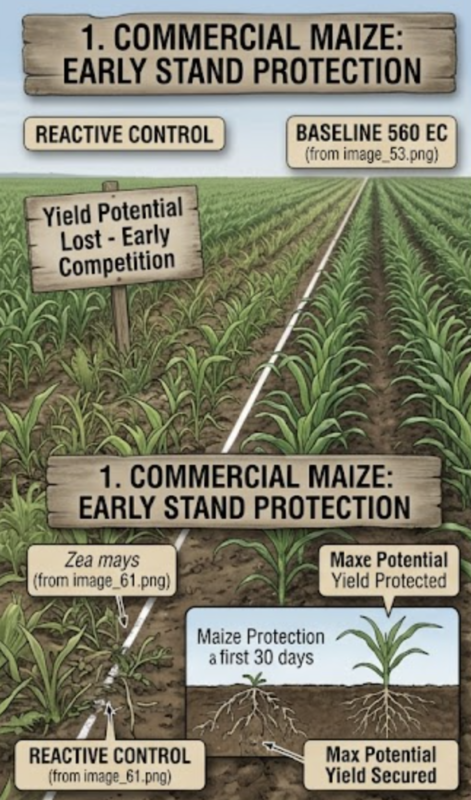
1. Commercial Maize (Zea mays)
Maize seedlings are especially vulnerable to early shading and root competition. Applying Baseline 560 EC at or immediately after planting eliminates heavy annual grass pressure, allowing maize roots to expand unhindered into moist soil profile zones.
2. Soybean & Dry Bean Operations
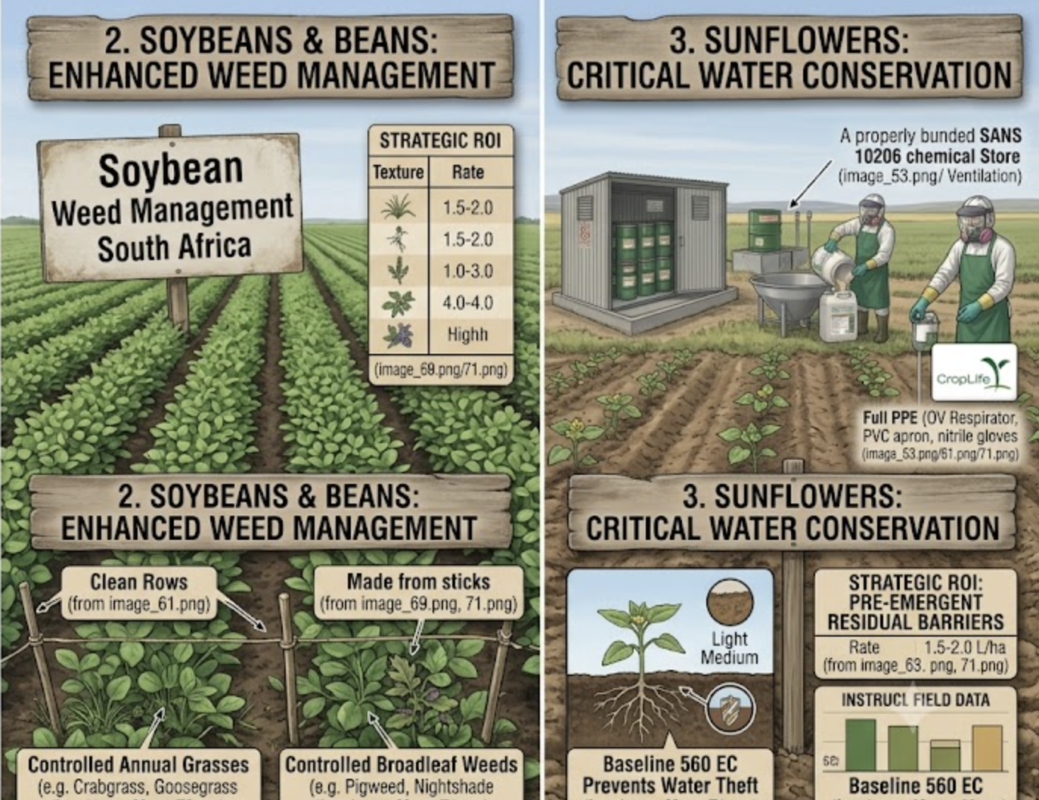
Effective soybean weed management South Africa wide requires suppressing broadleaf weed flushes that attempt to establish before row canopy closure. Baseline 560 EC stops stubborn broadleaf species before they choke out young bean seedlings, preserving light interception and soil moisture reserves.
3. Sunflower Production
Sunflowers rely heavily on early moisture conservation during germination. Integrating Baseline 560 EC as part of your sunflower crop protection chemicals program prevents competitive grass weeds from drawing down water in the upper seedbed during critical early emergence.
Target Weed Control Spectrum
Baseline 560 EC combines a Group 15 chloroacetamide (Acetochlor) and a Group 5 triazine (Terbuthylazine) to deliver dual-action control across a wide range of problem weed species:
Controlled Annual Grasses:
- Crabgrass (Digitaria sanguinalis)
- Goosegrass (Eleusine indica)
- Sweet Buffalo Grass (Panicum schinzii)
- Foxtail species (Setaria spp.)
- Yellow Nutsedge suppression (Cyperus esculentus)
Controlled Broadleaf Weeds:
- Redroot Pigweed (Amaranthus retroflexus)
- Common Blackberry / Nightshade (Solanum nigrum)
- Thorn Apple (Datura stramonium)
- Khaki Weed (Tagetes minuta)
- White Goosefoot (Chenopodium album)
Seasonal Crop Rotation & Pre-Emergent Application Rates
To optimize field results and crop safety, application rates must be adjusted according to soil clay percentage and crop type.
| Crop Type | Soil Clay Content (%) | Recommended Rate (L/ha) | Target Water Volume |
| Maize | Light (< 15%) | 1.5-2.0 L/ha | 150-200 L/ha |
| Maize | Heavy (> 35%) | 2.5-3.0 L/ha | 200-250 L/ha |
| Soybeans / Dry Beans | Medium (15%-30%) | 1.8-2.2 L/ha | 150-200 L/ha |
| Sunflowers | Light-Medium (15%-25%) | 1.5-2.0 L/ha | 150-200 L/ha |
Note: Always verify soil clay percentage via recent laboratory analysis prior to filling spray tanks.
On-Farm Agrochemical Storage, Handling & Stewardship Compliance
Safely incorporating Baseline 560 EC into your seasonal cropping workflow requires maintaining full alignment with chemical storage regulations, enforcing protocols for the safe disposal of pesticide containers, and taking active measures for preventing runoff.
                   Compliant Agrochemical Stewardship Loop
  ┌─────────────────────────────────────────────────────────────────────────────┐
  │                                                                             │
  │  [✓] Store Compliance (SANS 10206 - 110% Capacity Concrete Bunding)         │
  │  [✓] Personal Safety (OV Respirator, Nitrile Gauntlets, PVC Apron & Goggles)  │
  │  [✓] Environmental Safety (Maintain Grassed Buffer Strips & Water Checks)   │
  │  [✓] Certified Recycling (Triple-Rinse, Puncture Drum & Route to CropLife)  │
  │                                                                             │
  └─────────────────────────────────────────────────────────────────────────────┘
- Storage Compliance (SANS 10206): Keep emulsifiable concentrates inside a locked, cross-ventilated chemical store fitted with smooth concrete flooring and a 200 mm bund wall built to retain 110% of stored liquid volume.
- Herbicide Safety Gear: Operators handling concentrated EC formulations must wear chemical-resistant 14 + mil nitrile gauntlet gloves, heavy PVC aprons, splash goggles, and half-mask respirators fitted with Organic Vapor (OV) cartridges for complete farm worker chemical safety.
- Container Disposal & Runoff Prevention: Triple-rinse empty drums directly into the spray tank, puncture container bases to eliminate secondary reuse, and route plastic to an accredited CropLife SA collector. Maintain 10-20 meter vegetated filter strips near rivers, dams, and field drainage pathways to prevent runoff contamination during summer rain events.