
Uncategorized
Triple Distilled Mercury 99.99% Purity & CAS 7439-97-6 Guide
Aug
Learn what triple distilled mercury means, why 99.99% purity matters, key CAS 7439-97-6 specifications, quality documentation, safety, and compliance.
Understanding Triple Distilled Grade: Why 99.99% Purity Matters in Chemical Processing
High-purity materials play an important role in chemical processing, laboratory work, analytical applications, and specialized industrial systems. When a process requires tightly controlled material characteristics, understanding the difference between ordinary-grade and high-purity substances becomes particularly important.
The term triple distilled mercury is commonly used in descriptions of high-purity elemental mercury. However, triple distilled should not be treated as a purity specification by itself. The actual quality of a material should be established through appropriate analytical testing and documentation.
For organizations researching high purity elemental mercury or CAS 7439-97-6 specifications, this guide explains what purity means, how specifications should be evaluated, and why safety and regulatory compliance are essential when dealing with mercury.
What Is Triple Distilled Mercury?
Triple distillation refers to a purification approach in which a material undergoes repeated distillation stages intended to remove certain impurities.
In principle, repeated purification can produce a material with a higher degree of purity than the starting material. However, the number of distillation stages alone does not establish a particular purity percentage.
For this reason, a claim such as “triple distilled” should ideally be supported by analytical documentation showing the resulting composition. For industrial and laboratory quality control, the stated purity, testing method, batch information, and applicable specification are more meaningful than the term triple distilled alone.
Why Does 99.99% Purity Matter?
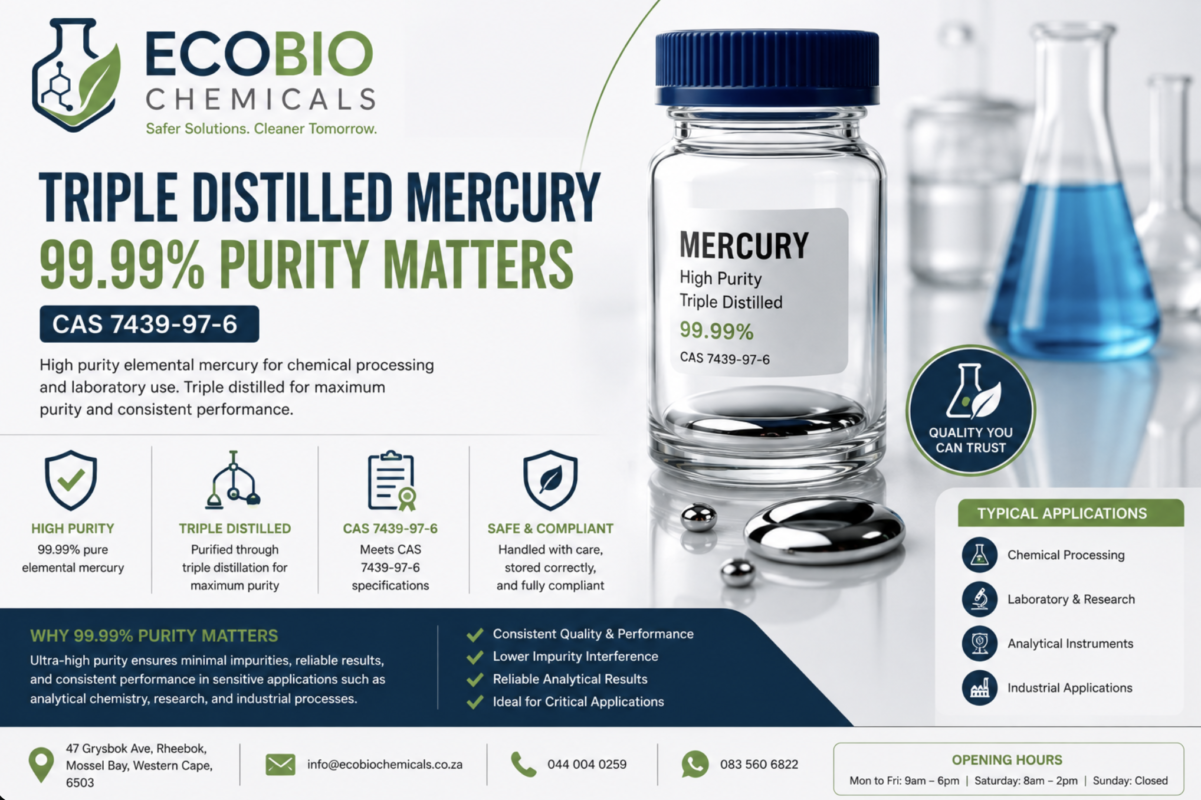
A stated purity of 99.99% means that mercury represents approximately 99.99% of the material, with the remaining fraction consisting of impurities or other substances.
In applications where material consistency is important, controlling impurities can help reduce uncertainty in analytical and technical processes. The significance of 99.99% purity depends on the particular application and the specifications established by the equipment manufacturer, laboratory method, or industrial process.
Important quality considerations include:
- Stated chemical purity
- Analytical testing method
- Impurity profile
- Batch or lot identification
- Certificate of Analysis (CoA)
- Safety Data Sheet (SDS)
- Traceability
- Applicable technical standards
A high-purity claim should therefore be supported by objective documentation rather than relying solely on product terminology.
Understanding High Purity Elemental Mercury
High purity elemental mercury refers to mercury that has been refined to meet a specified level of chemical purity.
Mercury is a distinctive elemental substance with a long history of use in scientific and industrial applications. Nevertheless, its toxicological and environmental characteristics mean that modern use is subject to significant safety and regulatory considerations.
High purity does not mean low hazard. A material can meet a stringent chemical specification while still presenting substantial occupational and environmental risks.
This distinction is especially important when developing purchasing specifications, laboratory procedures, risk assessments, and storage policies.
CAS 7439-97-6 Specifications Explained
CAS 7439-97-6 is the Chemical Abstracts Service Registry Number associated with elemental mercury.
A CAS number is useful for identifying a chemical substance consistently across technical and regulatory documentation. However, the CAS number itself does not define purity.
When reviewing CAS 7439-97-6 specifications, organizations should distinguish between:
- Chemical identity
- Purity specification
- Physical properties
- Impurity limits
- Analytical methods
- Hazard classification
- Storage requirements
- Transportation requirements
- Regulatory restrictions
A specification sheet and SDS should therefore be reviewed together when evaluating a mercury-containing material.
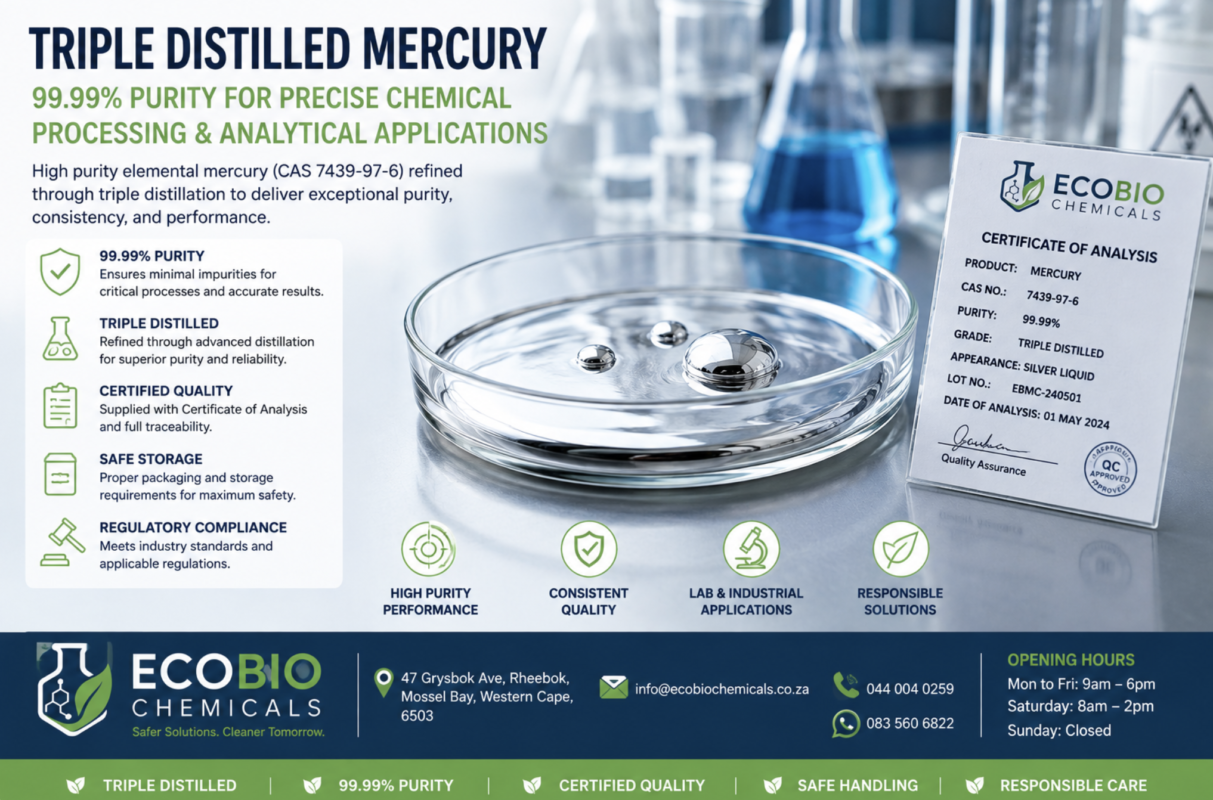
Certificate of Analysis for High-Purity Mercury
A Certificate of Analysis is an important quality-control document for high-purity industrial materials.
Depending on the supplier and applicable standards, a CoA may provide information such as the product identity, batch number, stated purity, analytical results, testing methodology, and date of analysis.
For a process requiring 99.99% purity, organizations should confirm that the analytical information actually supports the stated specification.
The CoA should also be traceable to the relevant batch or lot so that quality records can be maintained throughout the material’s lifecycle.
Why Mercury SDS Documentation Matters
A Safety Data Sheet (SDS) provides essential information concerning chemical hazards, handling precautions, storage, emergency response, exposure controls, and disposal considerations.
For mercury, SDS documentation is particularly important because exposure to mercury and mercury vapor can present serious health hazards.
Workers should receive appropriate training, and facilities that are legally permitted to handle mercury should establish suitable engineering controls, containment procedures, emergency protocols, and waste-management practices.
Mercury Storage Requirements
Mercury storage should be addressed as part of a broader hazardous-material management program.
Facilities should follow the applicable SDS, occupational-health requirements, environmental regulations, and local hazardous-material rules. Storage arrangements should minimize the possibility of accidental release, exposure, contamination, and unauthorized access.
Inventory control and documented spill-response procedures are also important components of responsible mercury management.
Mercury Regulations and Compliance
Mercury is subject to extensive regulation in many jurisdictions because of its toxicity and environmental persistence.
Depending on location and intended application, requirements may address possession, use, transportation, importation, exportation, storage, emissions, and disposal.
Organizations should therefore establish regulatory requirements before incorporating mercury into a process. Environmental, health and safety, legal, and technical teams may all have a role in determining whether a proposed application is permitted.
Mercury Alternatives and Modern Chemical Processing
An important consideration in modern process design is whether mercury is necessary at all.
Technological advances have produced alternatives for some historical mercury applications, including electronic measurement technologies, mechanical systems, non-mercury sensors, and other specialized materials.
A technical comparison should consider performance requirements, operating conditions, accuracy, maintenance, lifecycle cost, environmental impact, worker safety, and regulatory obligations.
Where a mercury-free alternative can satisfy the same engineering requirement, it may provide significant advantages in risk management and long-term compliance.
Frequently Asked Questions
What does triple distilled mercury mean?
Triple distilled mercury generally refers to mercury that has undergone three distillation or purification stages. However, the phrase itself does not guarantee a specific purity level. Analytical testing should be used to verify the actual specification.
Is 99.99% mercury considered high purity?
Yes. 99.99% represents a high-purity specification. The suitability of that purity depends on the requirements of the particular application.
What is CAS 7439-97-6?
CAS 7439-97-6 is the Chemical Abstracts Service Registry Number used to identify elemental mercury. It identifies the substance but does not establish a particular purity grade.
What documents should accompany high-purity mercury?
Relevant documentation may include a Certificate of Analysis, Safety Data Sheet, product specification, batch information, and applicable regulatory or transportation documentation.
Does high purity make mercury safer?
No. Chemical purity and toxicity are separate concepts. High-purity mercury can still present significant health and environmental hazards.
Conclusion
Understanding triple distilled mercury, high purity elemental mercury, and CAS 7439-97-6 specifications requires more than looking at a purity percentage or product description.
For professional chemical processing and laboratory quality control, the most reliable approach is to evaluate verified analytical results, impurity specifications, Certificates of Analysis, SDS documentation, traceability, and applicable regulations.
Most importantly, mercury should be treated as a hazardous substance regardless of whether it is described as triple distilled, high purity, or 99.99% pure. Organizations using or evaluating mercury should incorporate appropriate safety controls, regulatory review, and environmental management into every stage of its lifecycle.
Where technically feasible, evaluating mercury-free alternatives can also help reduce occupational and environmental risks while supporting modern chemical-processing and sustainability objectives.