Silver mercury
Mercury COA Analysis: 99.99% Purity & Verification Guide
Aug
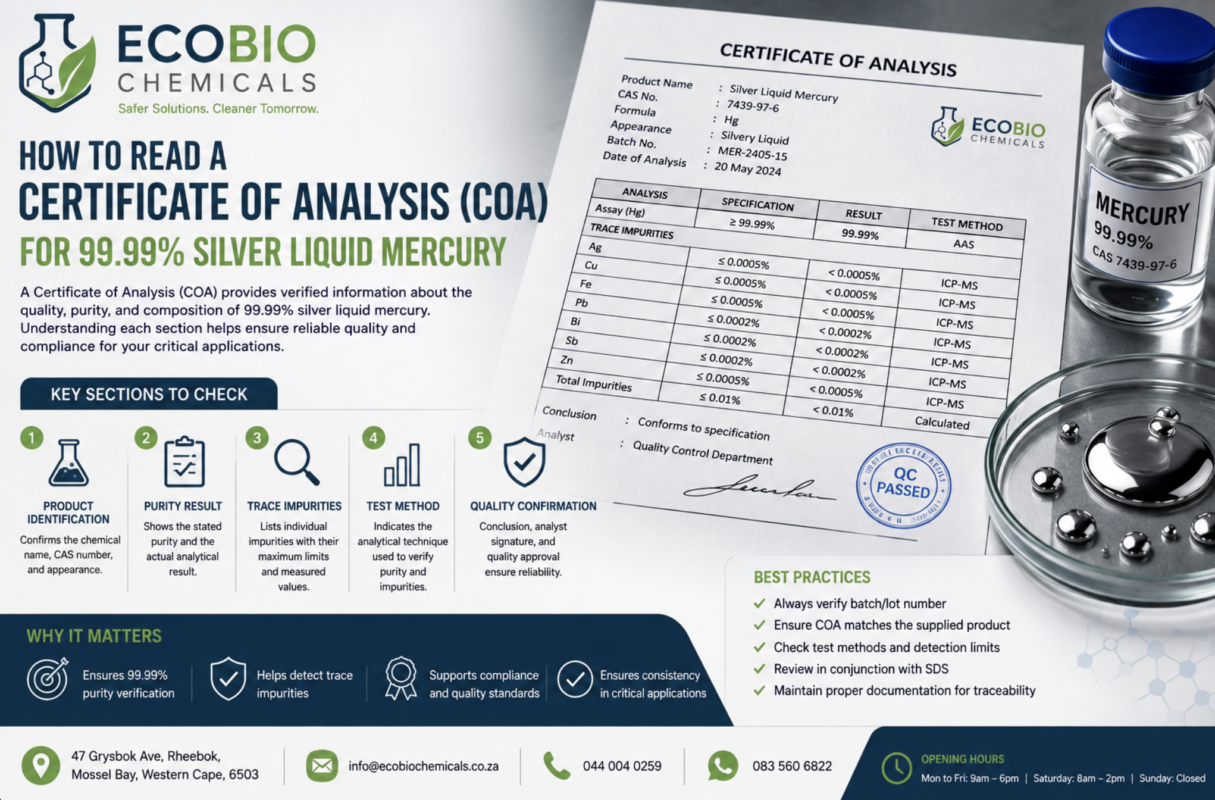
How to Read a Certificate of Analysis (COA) for 99.99% Silver Liquid Mercury
Learn how to read a mercury COA, understand trace impurities in liquid mercury, verify 99.99% purity, and evaluate quality documentation and standards.
Certificate of Analysis (COA) is one of the most important quality-control documents associated with high-purity chemical materials. For organizations evaluating 99.99% silver liquid mercury, understanding how to interpret a COA can help distinguish a documented material specification from a simple product claim.
A professional mercury COA analysis typically provides information about chemical identity, stated purity, batch or lot number, analytical testing, and other relevant quality characteristics. When purity is critical, the COA should be considered alongside the Safety Data Sheet (SDS), product specification, and applicable regulatory requirements.
This guide explains the key sections of a COA and what organizations should look for when evaluating trace impurities in liquid mercury.
What Is a Certificate of Analysis?
A Certificate of Analysis is a quality document issued for a specific batch or lot of material. It records analytical results or confirms that a material conforms to a stated specification.
Unlike a general product brochure, a COA should be connected to an identifiable batch. This traceability is particularly important for high-purity materials used in controlled industrial, laboratory, or analytical environments.
A typical COA may include:
- Product or chemical name
- Chemical identification number
- Batch or lot number
- Purity specification
- Actual analytical result
- Testing method
- Date of analysis
- Manufacturer or laboratory information
- Applicable quality specification
Understanding 99.99% Purity
A stated purity of 99.99% indicates that approximately 99.99% of the material is the specified substance, with the remaining fraction representing impurities or other components.
However, the percentage alone does not tell the complete quality story.
For example, two materials could both be described as 99.99% pure while having different impurity profiles. One application may be particularly sensitive to a specific contaminant, making the identity and concentration of individual impurities more important than the headline purity percentage.
This is why purity verification standards and analytical methodology matter.
How to Read the Purity Result
When reviewing a mercury COA, start by locating the section identifying the material’s purity specification.
Look for three key elements:
1. Specification
This indicates the required or claimed purity level, such as 99.99%.
2. Result
The analytical result indicates what was measured for the particular batch.
3. Test Method
The COA should identify, where applicable, the analytical technique or recognized method used to obtain the result.
A credible quality assessment should consider all three rather than focusing only on the percentage displayed in a product title.
Understanding Trace Impurities in Liquid Mercury
Trace impurities in liquid mercury can be important in applications requiring tightly controlled material composition.
Depending on the analytical specification, impurities may include trace quantities of other metallic or non-metallic substances. The significance of each impurity depends on the intended technical application.
A detailed specification may therefore provide individual impurity limits rather than simply stating a total purity percentage.
When reviewing a COA, check whether it provides:
- Individual impurity concentrations
- Maximum permitted limits
- Detection limits where relevant
- Analytical method
- Units of measurement
- Pass/fail specification
This information can provide a much clearer picture of material quality.
Why the Analytical Method Matters
Analytical results are meaningful only when the testing methodology is appropriate for the property being measured.
A COA may identify an instrumental or laboratory analytical technique used to determine purity or impurities. The appropriate method depends on the material, required detection limits, specification, and applicable standards.
For critical applications, organizations should establish which analytical methods are acceptable before evaluating supplier documentation.
It is also important to distinguish between a supplier’s internal quality specification and an independently recognized standard.
Batch and Lot Traceability
A high-quality COA should be traceable to the actual material being evaluated.
Check that the following information is consistent across the documentation:
Product → Batch/Lot Number → COA → Packaging/Label → Purchase Records
This traceability helps organizations maintain quality records and investigate potential discrepancies.
If a COA cannot be clearly connected to a particular batch, its usefulness for quality assurance is significantly reduced.
COA vs SDS: What’s the Difference?
A COA and an SDS serve different purposes.
A Certificate of Analysis primarily addresses material quality and conformity with a specification.
A Safety Data Sheet focuses on hazards, handling precautions, storage, exposure controls, emergency procedures, transportation information, and disposal considerations.
For mercury, both documents are important. A COA showing 99.99% purity does not mean the material is safe to handle without appropriate controls.
Purity Verification Standards and Quality Control
Organizations working with high-purity chemicals should establish documented purity verification standards appropriate to their application.
These may include:
- Defined purity specifications
- Approved analytical methods
- Acceptance criteria
- Batch traceability
- Documentation review
- Supplier qualification
- Periodic verification
- Record retention
For regulated or safety-critical materials, quality assurance should also consider applicable national and international requirements.
Common COA Red Flags
When reviewing a mercury COA or any high-purity chemical certificate, several issues deserve additional scrutiny.
Be cautious when documentation:
- Does not identify a batch or lot
- Provides a purity percentage without a testing method
- Contains inconsistent product identification
- Lacks a testing date
- Uses vague quality terminology without measurable specifications
- Cannot be linked to the supplied material
- Conflicts with the SDS or product specification
These issues do not automatically prove that a material is unsuitable, but they justify further verification before the material is accepted for a critical application.
Frequently Asked Questions
What does a 99.99% purity result mean?
It indicates that approximately 99.99% of the analyzed material meets the stated chemical identity, subject to the analytical method and specification used.
What are trace impurities in liquid mercury?
Trace impurities are small quantities of substances other than the specified mercury. Their importance depends on the application and the concentration of each contaminant.
Why is a mercury COA important?
A COA provides batch-specific quality information and helps organizations verify whether material conforms to a stated specification.
Does a COA prove that mercury is safe?
No. A COA addresses quality or composition. Safety information should be obtained from the applicable SDS and risk-management procedures.
What should I check first on a mercury COA?
Start with the product identity, CAS number where applicable, batch or lot number, purity specification, analytical result, testing method, and date of analysis.
Conclusion
Learning how to conduct a mercury COA analysis is essential when quality and consistency matter. A 99.99% purity claim is useful, but it should be supported by batch-specific analytical documentation and appropriate purity verification standards.
By examining the stated purity, analytical result, testing method, batch traceability, and trace impurities in liquid mercury, quality-control teams can make better-informed assessments of material conformity.
Most importantly, chemical purity should always be considered separately from chemical safety. Mercury remains a hazardous substance regardless of its purity level, and organizations handling it must follow applicable SDS instructions, occupational controls, environmental requirements, and regulatory obligations.