
Baseline 560 EC
Protecting Sunflower Crops from Early Weed Competition Using Baseline 560 EC
Aug
Using Baseline 560 EC to maximize sunflower yields. Early-season weed interference presents a major obstacle to achieving maximum yield in commercial sunflower (Helianthus annuus) production. Sunflowers grow rapidly once established, but young seedlings remain highly sensitive to weed competition during their first four to six weeks. Uncontrolled annual grasses and broadleaf weeds compete vigorously for light, soil nutrients, and moisture, leading to thin stands, delayed flowering, and reduced head size.
Applying a reliable residual herbicide for sunflowers like Baseline 560 EC right at planting creates an unbroken chemical barrier. This pre-emergence control suppresses aggressive weeds before they break through the soil surface, providing sunflowers with the clean field conditions needed for strong early root development.
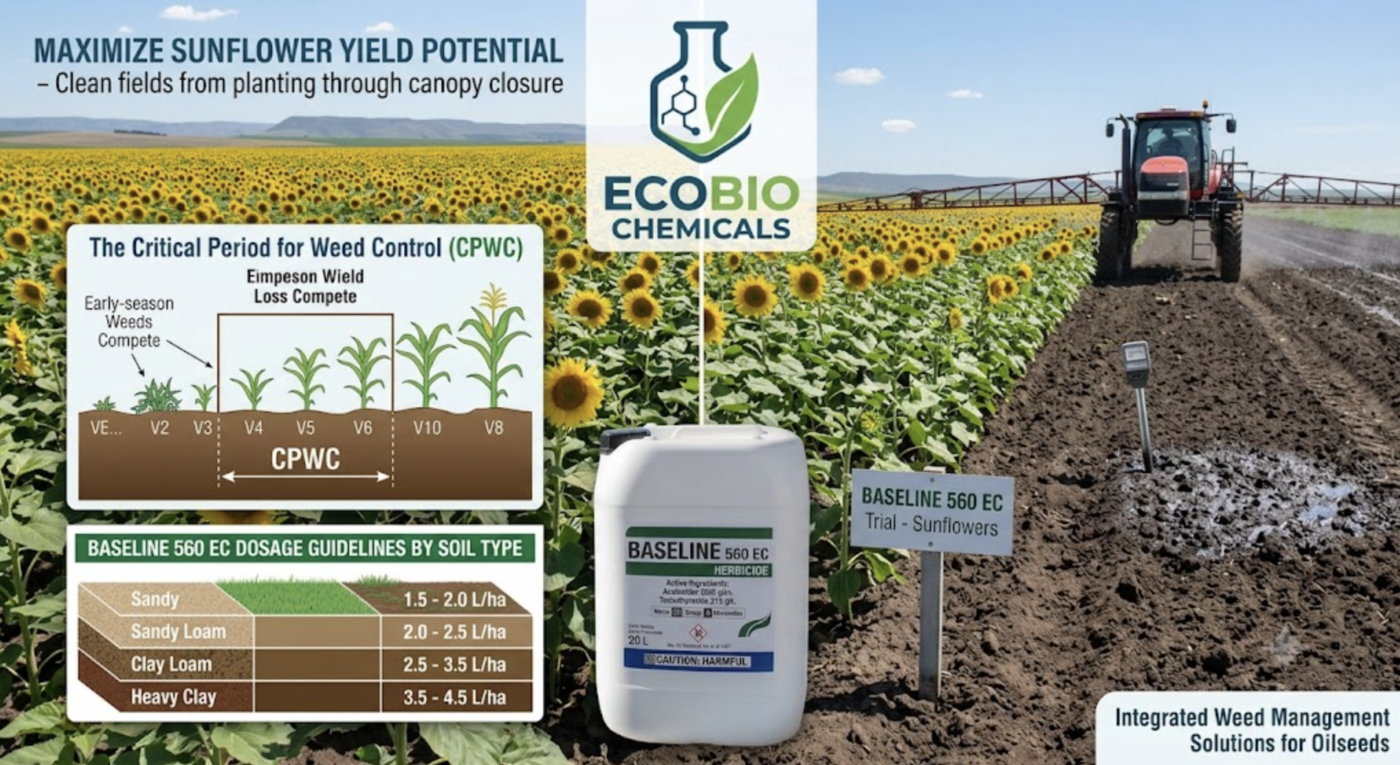
The Critical Competition Window in Sunflowers
Sunflower yields are heavily determined during early vegetative growth stages (from emergence up to the 8-leaf stage). Yield loss occurs when weeds extract vital soil moisture and nitrogen before the sunflower crop can establish canopy closure.
                  Critical Period for Weed Control (CPWC)
                              VE to V8 Stage
  ┌─────────────────────────────────────────────────────────────────────────────┐
  │                                                                             │
  │   Planting (VE) ─────────────► V4 Stage ─────────────► V8 Stage (Canopy)    │
  │        │                                                      │             │
  │        └────────────── MAXIMUM YIELD LOSS WINDOW ─────────────┘             │
  │                       (High risk of weed competition)                       │
  └─────────────────────────────────────────────────────────────────────────────┘
If weeds are allowed to emerge alongside sunflowers, root development is compromised, resulting in weaker stems and reduced drought resistance later in the season. Severe weed infestations during the VE to V8 growth phase can cause seed yield losses ranging from 20% to over 50%. Utilizing modern agricultural solutions eliminates early-season weed pressure and safeguards crop establishment.
How Baseline 560 EC Delivers Residual Protection
Baseline 560 EC combines two complementary active ingredients engineered to target problem broadleaf species and annual grasses through distinct biological pathways:
- Acetochlor (348 g/L): A Group 15 root and shoot growth inhibitor that halts cell division in germinating weed seeds as they attempt to breach the surface.
- Terbuthylazine (212 g/L): A Group 5 Photosystem II (PSII) inhibitor that provides broadleaf weed suppression via root uptake.
This dual-action formula forms a protective layer in the top 2-5cm of the soil profile, ensuring robust residual efficacy throughout the critical early-growth window.
Target Weed Spectrum with Baseline 560 EC
Pre-emergence treatment with Baseline 560 EC delivers wide-spectrum control over tough weed species common in field crops:
| Weed Category | Targeted Problem Species |
| Annual Grasses | Crabgrass (Digitaria sanguinalis), Goosegrass (Eleusine indica), Foxtails (Setaria spp.), Signal grass (Urochloa spp.) |
| Broadleaf Weeds | Pigweed / Amaranth (Amaranthus spp.), Black nightshade (Solanum nigrum), Common goosefoot (Chenopodium album), Khaki weed (Tagetes minuta) |
Application Rates by Soil Clay Percentage
To ensure high efficacy while maintaining crop safety, calibrate Baseline 560 EC dosage rates according to your field’s soil clay content:
| Soil Classification | Clay Percentage | Dosage Rate (L/ha) | Carrier Water Volume (L/ha) |
| Light / Sandy | 0%-10% Clay | 1.5 L/ha | 100-200 L |
| Sandy Loam | 11% – 20% Clay | 2.0 L/ha | 100-200 L |
| Clay Loam | 21%-35% Clay | 2.5-3.0 L/ha | 150-250 L |
| Heavy Clay | > 35% Clay | 3.0 L/ha | 150-300 L |
Key Best Practices for Sunflower Safety
For optimal sunflower crop protection and weed control, follow these agronomic recommendations:
- Uniform Planting Depth: Plant sunflower seeds into a smooth, firm seedbed at a uniform depth of at least 35-50mm to ensure the crop seed sits well below the herbicide treatment layer.
- Activating Rainfall or Irrigation: Baseline 560 EC requires 10-15mm of rainfall or overhead irrigation within 7 to 10 days post-application to move the active ingredients into the weed germination zone.
- Avoid Waterlogged Soils: Do not apply in waterlogged fields or shallow soil depressions where standing water can pool, as high local concentrations can cause temporary crop stress.
Integrating Baseline 560 EC into your seasonal management program provides dependable weed suppression, promotes uniform canopy closure, and secures optimal head development at harvest.