
Baseline 560 EC
How Baseline 560 EC Controls Annual Grasses and Broadleaf Weeds
Aug
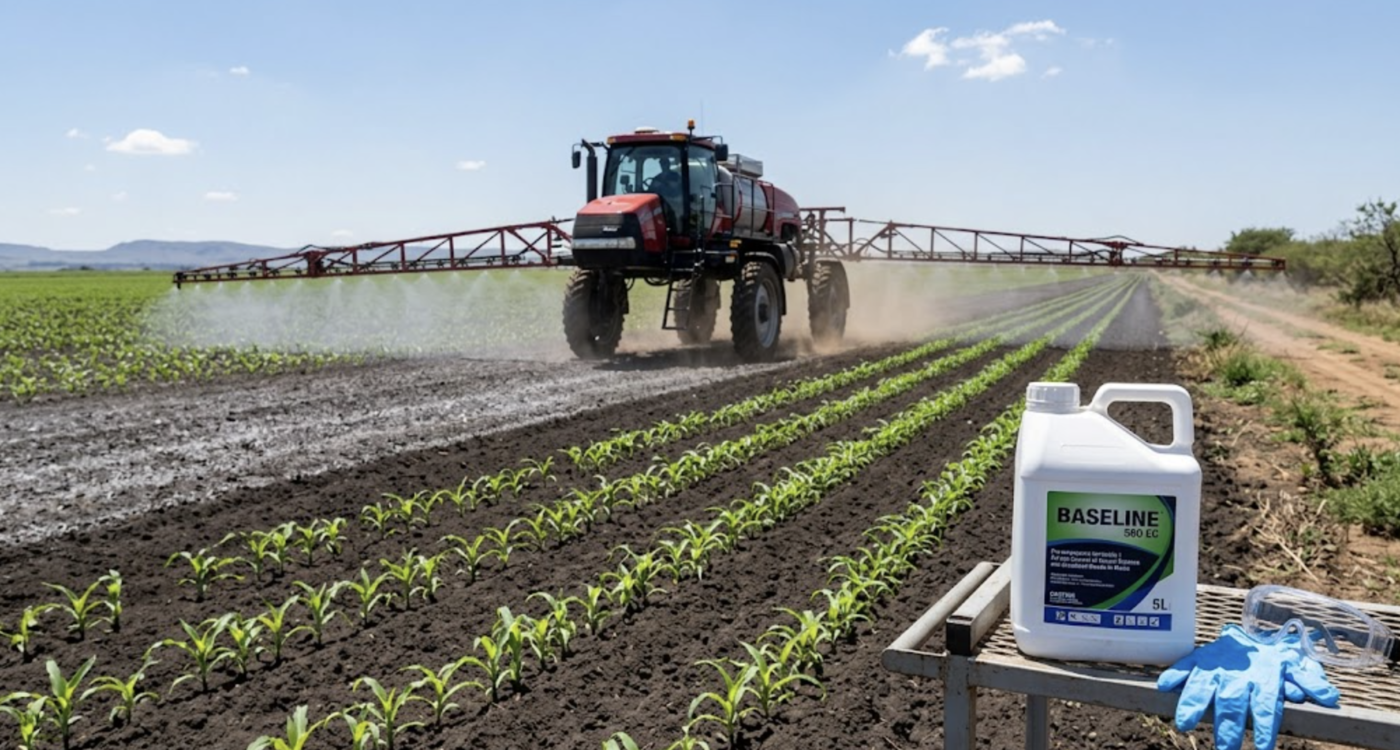
Baseline 560 EC South Africa. Controlling annual grasses and broadleaf weeds before they emerge is the single most critical step in protecting young crop yields. Baseline 560 EC is designed specifically to eliminate high weed pressure in maize production by establishing a durable, soil-active chemical barrier.
This guide explains how Baseline 560 EC targets weed seeds during germination to provide reliable pre-emergence herbicide protection.
Dual-Action Chemistry for Full-Spectrum Control
Baseline 560 EC combines two complementary active ingredients to tackle diverse weed profiles simultaneously:
- Acetochlor (348 g/L): A Group 15 root and shoot inhibitor that primarily targets germinating annual grasses and selected broadleaf weeds.
- Terbuthylazine (212 g/L): A Group 5 photosystem II inhibitor that delivers residual control against troublesome annual broadleaf species.
By co-formulating these two actives into an emulsifiable concentrate (EC), the mixture targets two separate physiological pathways within weed seedlings, drastically reducing the chance of herbicide resistance.
Mechanism of Action: Stopping Weeds Before Emergence
For effective annual grass control and broadleaf weed management, timing and placement are essential. Baseline 560 EC works directly in the top 2-5 cm of the soil surface the primary germination zone for weed seeds.
                  ┌─────────────────────────────────────┐
                  │ Baseline 560 EC Soil Activation Layer│
                  └──────────────────┬──────────────────┘
                                     │
           ┌─────────────────────────┴─────────────────────────┐
           ▼                                                   ▼
┌──────────────────────┐                           ┌──────────────────────┐
│  Acetochlor Action   │                           │Terbuthylazine Action │
├──────────────────────┤                           ├──────────────────────┤
│ Absorbed by shoot &  │                           │ Absorbed by roots &  │
│ developing roots     │                           │ emerging foliage     │
│ Stops cell division  │                           │ Blocks photosynthesis│
└──────────┬───────────┘                           └──────────┬───────────┘
           │                                                  │
           ▼                                                  ▼
Grass shoots fail to emerge                           Broadleaf seedlings
 or wither upon germination                             yellow and collapse
1. Annual Grass Control (Acetochlor Phase)
- Absorption: As grass seeds germinate, the emerging shoots (coleoptiles) absorb acetochlor from the surrounding treated soil profile.
- Effect: It prevents very long-chain fatty acid (VLCFA) synthesis, halting cell division.
- Target Species: Effectively controls crabgrass (Digitaria spp.), goosegrass (Eleusine indica), barnyard grass (Echinochloa crus-galli), and foxtails (Setaria spp.).
2. Broadleaf Weed Management (Terbuthylazine Phase)
- Absorption: Germinating broadleaf seeds absorb terbuthylazine through their nascent root systems and early tissue.
- Effect: It translocates upward and disrupts Photosystem II, preventing the plant from turning sunlight into chemical energy.
- Target Species: Controls pigweeds (Amaranthus spp.), fat-hen (Chenopodium album), black nightshade (Solanum nigrum), and common cocklebur (Xanthium strumarium).
Best Practices for Maximizing Residual Activity
To ensure your pre-emergence herbicide application delivers maximum weed suppression, follow these key agronomic guidelines:
- Seedbed Preparation: Apply to a fine, firm seedbed free of large clods or dense crop residue, which can shadow the soil surface and leave untreated gaps.
- Moisture Activation: Incorporate the treatment with light rainfall or irrigation (10-15mm) within 7 to 10 days to move the active ingredients into the seed germination layer.
- Adjust Rates for Soil Clay Content:
- Coarse/Sandy soils (< 15% clay): Use lower labeled rates to maintain crop safety.
- Heavy/Clay soils (> 35% clay): Use higher labeled rates to compensate for soil particle binding.
Strategic Summary
Using Baseline 560 EC as your core pre-emergence treatment simplifies early-season management by stopping weeds before they compete with young maize plants for moisture, nutrients, and sunlight.
Application rates for Baseline 560 EC (Acetochlor 348 g/L + Terbuthylazine 212 g/L) depend directly on the soil clay percentage, organic matter content, and target weed spectrum.
Because heavy clay soils adsorb more active ingredient while light sandy soils risk chemical leaching and crop root injury, calibration by soil texture is critical.
Standard Pre-Emergence Application Rates (Maize)
| Soil Clay Percentage (% Clay) | Soil Texture Classification | Baseline 560 EC Dosage (L/ha) | Spray Volume (L/ha) |
| 0% – 10% | Light / Very Sandy | 1.5-2.0 L/ha | 100-200L |
| 11% – 20% | Light-Medium / Sandy Loam | 2.0-2.5 L/ha | 100-200 L |
| 21% – 35% | Medium / Clay Loam | 2.5-3.5 L/ha | 150-250 L |
| > 35% | Heavy / High Clay Content | 3.5-4.5 L/ha | 150-300 L |
Critical Application Guidelines
- Organic Matter Adjustment: If the soil organic matter exceeds 1.0%, select the higher rate within the recommended clay percentage bracket.
- Yellow Nutsedge & High Grass Pressure: For suppressing heavy annual grass pressure or yellow nutsedge (Cyperus esculentus), use the upper dosage end for that specific soil bracket.
- Soil Activation: Ensure 10-5mm of rainfall or overhead irrigation occurs within 7–10 days of application to activate the chemical barrier in the root zone.
- Coarse/Sandy Soils Warning (<10% clay): Avoid over-application on low-clay, highly permeable soils under heavy rainfall to prevent crop injury or leaching past the germination zone.