
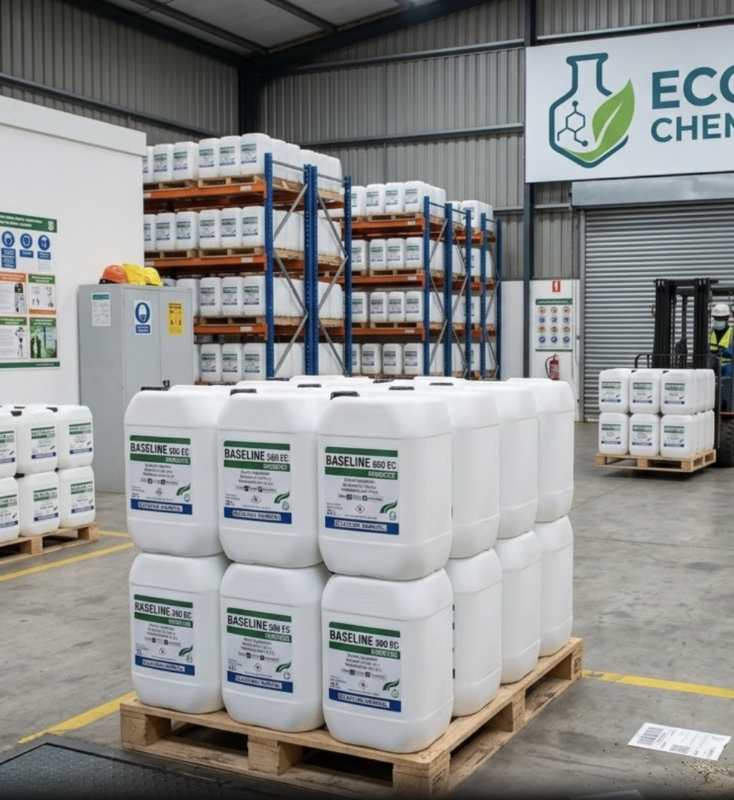
Baseline 560 EC
Baseline 560 EC :Understanding the Mode of Action: Chloroacetamide & Triazine in Baseline 560 EC
Aug
Baseline 560 EC suppliers. Effective pre-emergence weed control relies heavily on using complementary active ingredients to attack weeds from multiple biological angles. Baseline 560 EC achieves high-level suppression of annual grasses and broadleaf weeds in maize crops through a dual-action formula.
Understanding the underlying chemical processes – specifically how chloroacetamide and triazine active ingredients target distinct biochemical pathways – helps optimize field applications and prevent herbicide resistance.
Active Ingredients at a Glance
Baseline 560 EC combines two primary active ingredients, each belonging to a distinct chemical family:
| Active Ingredient | Chemical Family | HRAC Group | Primary Role |
| Acetochlor (348\ g/L) | Chloroacetamide | Group 15 | Annual grass & selective broadleaf control |
| Terbuthylazine (212\ g/L) | Triazine | Group 5 | Broad-spectrum annual broadleaf control |
1. Chloroacetamide Mode of Action (Acetochlor)
The acetochlor component in Baseline 560 EC targets emerging seedlings primarily before they break through the soil surface.
- Primary Pathway: Inhibition of very long-chain fatty acid (VLCFA) synthesis.
- Target Mechanism: Acetochlor disrupts the enzymes responsible for elongating fatty acids essential for building cell membranes, plant cuticles, and protective wax layers in developing shoots.
- Effect on Seedlings: As germinating grass shoots absorb the chemical from soil moisture, cell division and seedling development stall. Affected weed shoots fail to emerge or appear stunted, distorted, and dark green before rapidly dying underground.
While historically grouped under general protein synthesis inhibition pathways due to its downstream disruption of cellular development, modern herbicide classification specifically places acetochlor in HRAC Group 15 (VLCFA synthesis inhibitors).
2. Triazine Mode of Action (Terbuthylazine)
The terbuthylazine component delivers complementary residual control by targeting photosynthetic machinery within weed seedlings.
- Primary Pathway: Inhibition of Photosystem II (PSII).
- Target Mechanism: Terbuthylazine binds to the Dı protein site in the thylakoid membrane of plant chloroplasts, blocking electron transport during photosynthesis.
- Effect on Seedlings: When germinating broadleaf weeds absorb terbuthylazine through their roots, the blocked photosynthetic chain produces reactive oxygen species (ROS). These free radicals destroy plant cell membranes, leading to rapid tissue breakdown.
- Visual Symptoms: Broadleaf seedlings show chlorosis (yellowing) along leaf margins, followed by necrosis (browning) and collapse upon exposure to sunlight.
Why the Dual Mode of Action Matters
Combining a chloroacetamide shoot inhibitor with a triazine photosynthetic inhibitor provides key agronomic benefits:
               ┌──────────────────────────────────────┐
               │ Baseline 560 EC Chemical Dual-Action │
               └──────────────────┬───────────────────┘
                                  │
          ┌───────────────────────┴───────────────────────┐
          ▼                                               ▼
┌──────────────────┐                            ┌──────────────────┐
│   Acetochlor     │                            │  Terbuthylazine  │
│    (Group 15)    │                            │    (Group 5)     │
├──────────────────┤                            ├──────────────────┤
│ - Shoot uptake   │                            │ - Root uptake    │
│ - Halts VLCFA    │                            │ - Blocks electron│
│   synthesis      │                            │   transport      │
└────────┬─────────┘                            └────────┬─────────┘
         │                                               │
         └───────────────────────┬───────────────────────┘
                                 ▼
                 ┌──────────────────────────────┐
                 │  Key Agronomic Advantages:   │
                 │  • Dual-pathway weed kill    │
                 │  • Resistance mitigation     │
                 │  • Extended soil residual    │
                 └──────────────────────────────┘
- Synergistic Control: Shoots and roots absorb active ingredients simultaneously, tackling tough annual grasses like Digitaria and broadleaf species like Amaranthus.
- Resistance Management: Utilizing two distinct target site mechanisms reduces selection pressure for resistant weed populations on your land.
- Extended Residual Barrier: The balance between soil mobility and adsorption provides lasting suppression through the critical early crop-establishment phase.
Application Considerations
For maximum performance of both modes of action:
- Soil Moisture: Requires 10-15mm of rainfall or overhead irrigation within 7-10 days of application to move both active ingredients into the top 2-5cm root/shoot absorption zone.
- Clay Calibration: Adjust application rates according to soil clay content to prevent rapid leaching in light soils or chemical tie-up in high-clay fields.