
Baseline 560 EC
Weed Management in Soybeans and Dry Beans with Baseline 560 EC
Aug
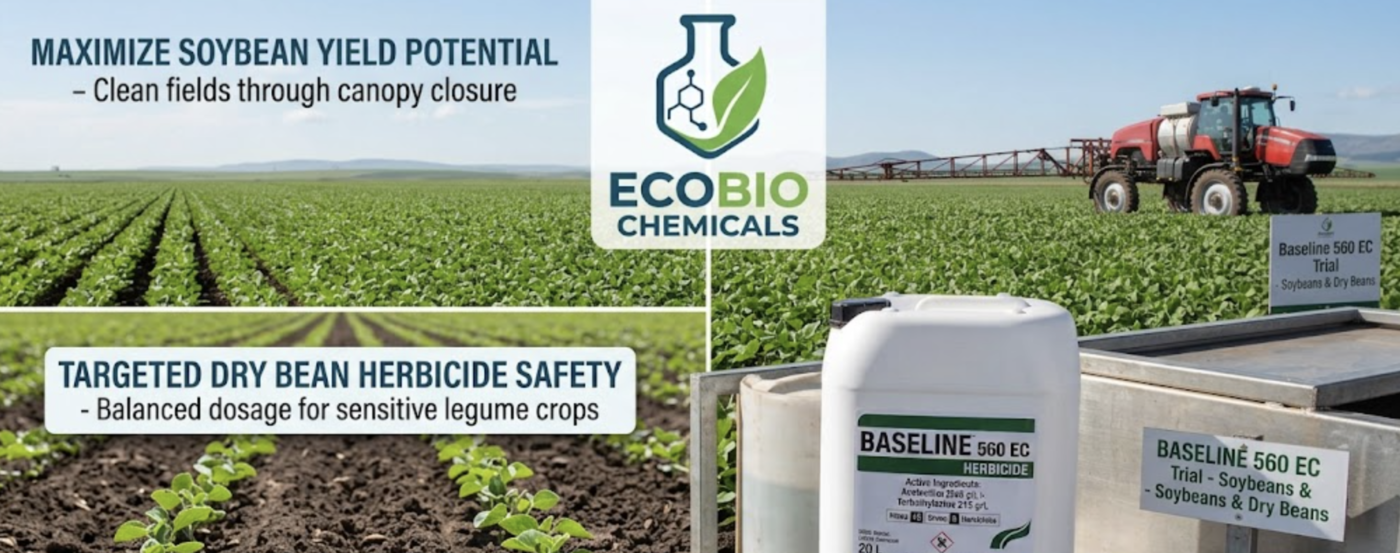
Soybeans and Dry beans using Baseline 560 EC
Effective early season weed management is essential for securing high harvest quality and maximum yield potential in pulse crops. Soybeans (Glycine max) and dry beans (Phaseolus vulgaris) are particularly vulnerable to early weed competition due to their slower initial canopy closure compared to high stature crops like maize.
Implementing a targeted pre-emergence program using Baseline 560 EC establishes a robust barrier against aggressive grass and broadleaf weeds, ensuring clean bean fields from planting through canopy closure.
The Risk of Early Weed Competition in Legumes
Uncontrolled weeds during the first 30 to 45 days post-emergence can severely compromise legume yield development:
             Critical Period for Weed Control (CPWC) in Legumes
                              Vegetative Stages (VC to V4)
  ┌─────────────────────────────────────────────────────────────────────────────┐
  │                                                                             │
  │   Planting (VE) ─────────────► V2 Stage ─────────────► V4 Stage (Canopy)    │
  │        │                                                      │             │
  │        └────────────── CRITICAL COMPETITION WINDOW ───────────┘             │
  │                       (Yield reduction risk: 30% - 70%)                     │
  └─────────────────────────────────────────────────────────────────────────────┘
During early growth stages, weed species such as pigweed (Amaranthus spp.) and crabgrass (Digitaria spp.) outpace pulse crops in root development and light absorption. Severe infestations reduce nodulation efficiency, cause plant stunting, and significantly lower pod set counts per plant.
Furthermore, late-season weed escapes complicate harvesting operations, increase seed moisture content at harvest, and introduce foreign weed seeds that lower commercial market grading.
Herbicide Synergy & Selectivity in Pulse Crops
Selecting pre-emergence chemistry for legumes requires balancing weed control efficacy with strict crop safety:
- Dual Mode-of-Action Protection: Baseline 560 EC combines Acetochlor ( 348 g/L), a Group 15 VLCFA synthesis inhibitor, with Terbuthylazine (212 g/L), a Group 5 PSII inhibitor. This dual-action mixture stops germinating grass seedlings and broadleaf weeds before they breach the surface.
- Evaluating Dry Bean Herbicide Safety: Dry beans and soybeans process herbicides through specific enzymatic pathways. Application parameters such as soil texture, planting depth, and moisture management must be precisely followed to maintain high selectivity and prevent crop injury.
Application Rates by Soil Texture
Dosage rates must be strictly calibrated based on soil clay percentage to maintain balance between efficacy and crop safety:
| Soil Classification | Clay Content | Application Rate (L/ha) | Recommended Water Volume (L/ha) |
| Light / Sandy | 0%-10% Clay | 1.5 L/ha | 100-200 L/ha |
| Sandy Loam | 11%-2% Clay | 2.0 L/ha | 100-200 L |
| Clay Loam | 21%-35% Clay | 2.5-3.0 L/ha | 150-250 L |
| Heavy Clay | > 35% Clay | 3.0-3.5 L/ha | 150-300 L |
Note: On extremely light, sandy soils (<10% clay) with low organic matter, verify local field safety recommendations before pre-emergence treatment.
Target Weed Spectrum Controlled
Pre-emergence treatment delivers broad-spectrum suppression of competitive species:
Annual Grasses Controlled
- Crabgrass (Digitaria sanguinalis)
- Goosegrass (Eleusine indica)
- Foxtails (Setaria spp.)
- Signal grass (Urochloa spp.)
Key Broadleaf Weeds Controlled
- Pigweed / Amaranth (Amaranthus spp.)
- Black nightshade (Solanum nigrum)
- Common goosefoot (Chenopodium album)
- Khaki weed (Tagetes minuta)
Field Protocol for Maximum Efficacy & Crop Safety
To achieve optimal soybean weed management while safeguarding seed germination, follow these key agronomic practices:
                            Best Practices Checklist
  ┌─────────────────────────────────────────────────────────────────────────────┐
  │                                                                             │
  │  1. Seed Depth      : Ensure uniform planting depth (minimum 30–40 mm).    │
  │  2. Seedbed Quality : Prepare a firm, clod-free surface for even coverage. │
  │  3. Moisture Input  : Requires 10–15 mm rainfall/irrigation within 7–10 days.│
  │  4. Tank Agitation  : Maintain continuous agitation during spraying runs.   │
  │                                                                             │
  └─────────────────────────────────────────────────────────────────────────────┘
- Proper Planting Depth: Plant pulse seeds into firm soil at a uniform depth of at least 30-40mm. Placing seeds below the direct chemical barrier zone prevents early root contact during germination.
- Soil Moisture Activation: Baseline 560 EC requires 10-15mm of activating rainfall or overhead center-pivot irrigation within 7 to 10 days post-application to incorporate active ingredients into the upper soil profile.
- Avoid Standing Water: Do not apply in poorly drained, waterlogged fields or shallow depressions where pooling water can cause chemical concentration around emerging crop shoots.
Applying Baseline 560 EC within an integrated weed management strategy protects legume establishment, supports early root nodulation, and maintains clean fields through harvest.