
Baseline 560 EC
Maximizing Maize Yields with Baseline 560 EC
Aug
Using Baseline 560 EC for Early-Season Weed Control
Early-season weed competition is one of the single greatest threats to commercial maize production. During the first critical six to eight weeks after planting, emerging maize seedlings compete directly with fast-growing annual grasses and broadleaf weeds for moisture, soil nutrients, and sunlight.
Implementing a robust pre-emergence weed control program using Baseline 560 EC protects yield potential right from planting, ensuring young maize establishes strong root systems and uniform canopy development.
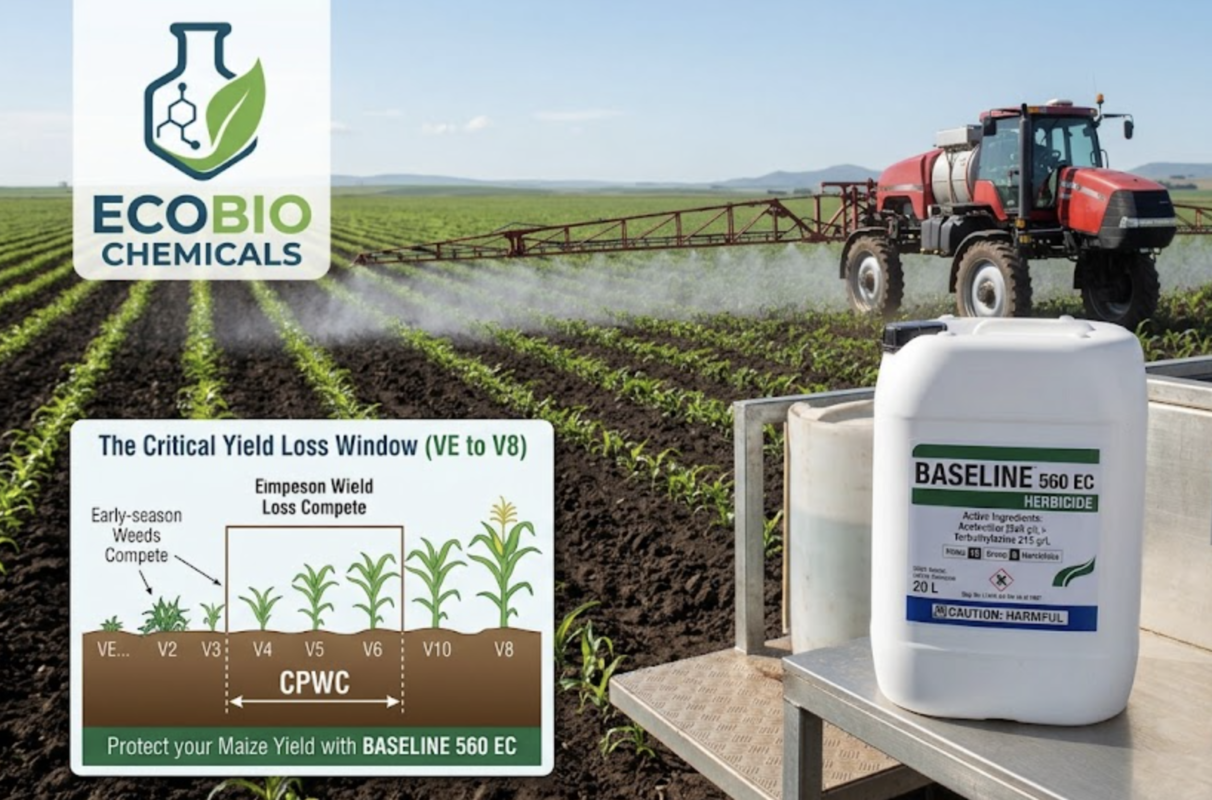
The Critical Yield Loss Window in Maize Production
Early weed suppression is vital because yield loss in maize begins long before weeds become visible above the canopy.
                       Critical Period for Weed Control (CPWC)
                                   VE to V8 Stage
  ┌───────────────────────────────────────────────────────────────────────────────┐
  │                                                                               │
  │   Planting (VE) ──────────────► V4 Stage ──────────────► V8 Stage (Canopy)   │
  │        │                                                      │               │
  │        └────────────── MAXIMUM YIELD LOSS WINDOW ─────────────┘               │
  │                        (High risk of weed competition)                        │
  └───────────────────────────────────────────────────────────────────────────────┘
When weeds germinate alongside maize crops, they drain essential nitrogen, phosphorus, and moisture from the top layer of soil. Uncontrolled weed growth during the VE to V8 growth stages can result in yield reductions ranging from 25% to over 60%, depending on weed density and environmental stress.
Using an effective pre-emergent for maize eliminates this early competition before weed seedlings can disrupt crop establishment.
Why Baseline 560 EC is Built for Maize Protection
Baseline 560 EC combines two high-performance active ingredients engineered to target problem weeds from multiple biological pathways:
- Acetochlor (348 g/L): A Group 15 root and shoot growth inhibitor that halts cell division in germinating annual grasses and key broadleaf species.
- Terbuthylazine (212 g/L): A Group 5 Photosystem II (PSII) inhibitor that targets broadleaf weeds through root uptake and systemic action.
Together, these active ingredients form an unbroken chemical barrier in the top 2-5 cm of the soil profile, delivering extended residual activity through the critical early-growth phase.
Broad-Spectrum Target Weed List
Baseline 560 EC targets the most troublesome annual grass and broadleaf species impacting field crops:
| Weed Classification | Targeted Problem Species |
| Annual Grasses | Crabgrass (Digitaria sanguinalis), Goosegrass (Eleusine indica), Foxtails (Setaria spp.), Signal grass (Urochloa spp.) |
| Broadleaf Weeds | Pigweed / Amaranth (Amaranthus spp.), Black nightshade (Solanum nigrum), Goosefoot (Chenopodium album), Khaki weed (Tagetes minuta) |
Field Dosage & Application Recommendations
Achieving precise corn weed control in South Africa and global maize-growing regions requires matching product dosage to your specific soil clay percentage:
                            Dosage Guidelines by Soil Type
  ┌───────────────────────────────────────────────────────────────────────────────┐
  │                                                                               │
  │  Light / Sandy (<10% Clay)   : 1.5 - 2.0 L/ha                                 │
  │  Sandy Loam (11% - 20% Clay) : 2.0 - 2.5 L/ha                                 │
  │  Clay Loam (21% - 35% Clay)  : 2.5 - 3.5 L/ha                                 │
  │  Heavy Clay (>35% Clay)      : 3.5 - 4.5 L/ha                                 │
  │                                                                               │
  └───────────────────────────────────────────────────────────────────────────────┘
Best Practices for Application
- Seedbed Preparation: Ensure a fine, firm seedbed free of large soil clods and excessive crop residue to allow uniform spray coverage across the soil surface.
- Moisture Requirement: Baseline 560 EC requires 10-15 mm of rainfall or overhead irrigation within 7 to 10 days post-application to wash the active ingredients into the weed seed germination zone.
- Carrier Volume: Calibrate equipment to deliver 100-250 L/ha of clean water carrier using flat-fan nozzles operating at 2-3 bar pressure.
Key Agronomic Advantages of Baseline 560 EC
- Dual-Pathway Resistance Management: Combining Group 15 and Group 5 modes of action reduces selection pressure for resistant weed biotypes on your farm.
- Crop Safety: Formulated specifically for high selective safety in maize when applied according to recommended soil clay guidelines.
- Rotational Flexibility: Terbuthylazine provides stable soil activity with favorable breakdown characteristics, supporting crop rotation plans for broadleaf crops in subsequent seasons.
Integrating Baseline 560 EC into your early-season chemical program establishes clean field conditions, protects crop vigor, and secures maximum harvest yields.