
Uncategorized
Sugarcane Weed Control Strategies: The Role of Baseline 560 EC
Aug
Sugarcane (Saccharum officinarum) is an intensive, long-season crop where effective weed management directly determines final sucrose yield and profitability. Because sugarcane has a slow initial growth rate often taking up to three months to achieve full canopy closure in plant cane and ratoon cycles the crop remains exposed to aggressive weed competition for an extended duration.
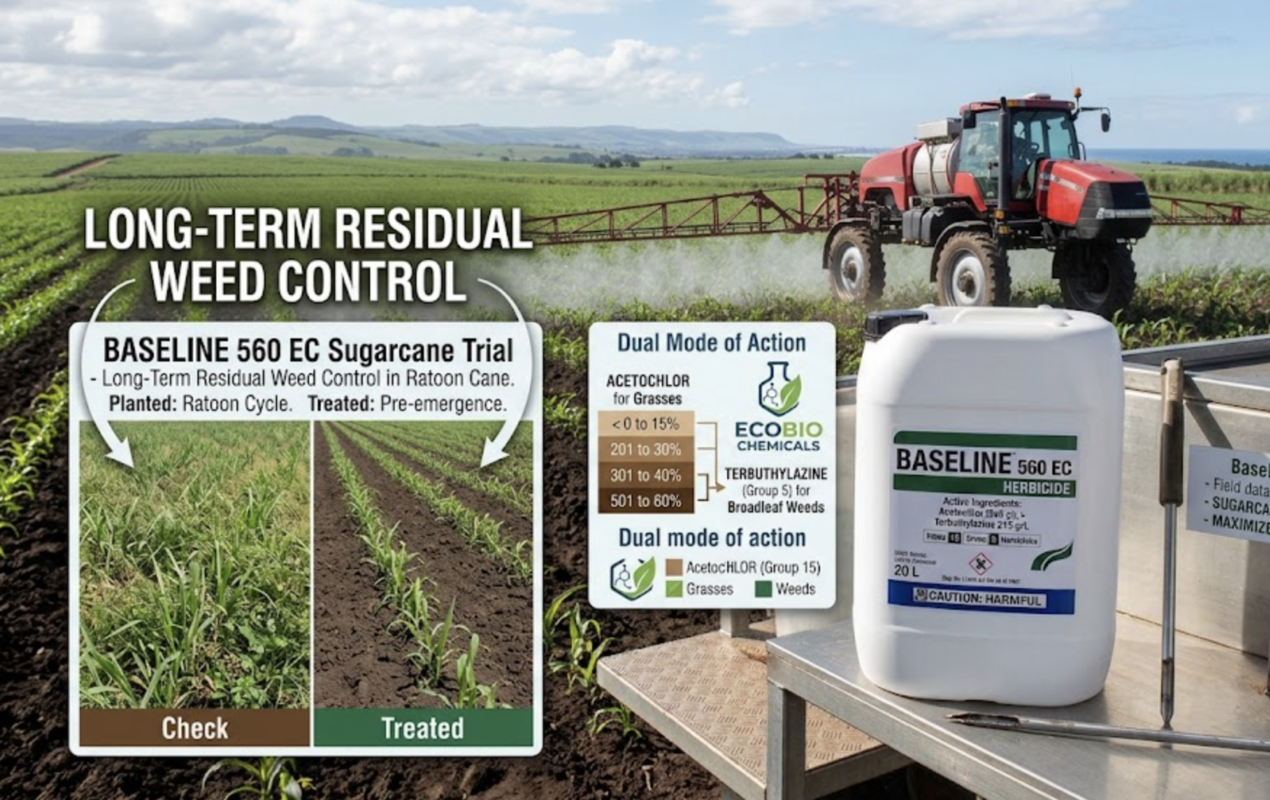
Implementing a robust pre-emergence strategy using Baseline 560 EC provides the long-lasting residual weed control in sugarcane required to protect emerging shoots, maximize nutrient uptake, and secure maximum yield per hectare.
The Economics of Early Weed Competition in Sugarcane – Baseline 560 EC
Weed competition during the early growth stages is one of the primary drivers of yield loss in commercial sugarcane operations. Fast-growing annual grasses and broadleaf weeds compete directly with young crop tillers for critical resources:
- Soil Moisture & Nutrients: Weeds absorb mobile nutrients, particularly nitrogen and potassium, faster than emerging sugarcane tillers, suppressing early root establishment.
- Sunlight & Stool Development: Uncontrolled weed growth shades young ratoon and plant cane shoots, causing tiller mortality, reduced stool density, and lower stalk counts at harvest.
- Harvest Efficiency & Purity: Late-season weed escapes increase trash content during manual or mechanical harvesting, lowering sucrose extraction rates at the mill.
A pre-emergence treatment eliminates weed competition during the critical early-season window, ensuring young sugarcane tillers establish without resource pressure.
Technical Performance: Dual Mode-of-Action Residual Control
Baseline 560 EC combines two high-performance active ingredients engineered to target problem weeds through complementary biological pathways:
                      Baseline 560 EC Active Ingredient Profile
  ┌─────────────────────────────────────────────────────────────────────────────┐
  │                                                                             │
  │  Acetochlor (348 g/L)      : Group 15 VLCFA Inhibitor                        │
  │                              • Halts cell division in germinating grasses   │
  │                              • Primary uptake through shoots and roots      │
  │                                                                             │
  │  Terbuthylazine (212 g/L)  : Group 5 PSII Inhibitor                         │
  │                              • Blocks photosynthesis in broadleaf weeds     │
  │                              • Provides strong soil residual stability      │
  │                                                                             │
  └─────────────────────────────────────────────────────────────────────────────┘
This dual-action mechanism creates a durable chemical barrier in the top 2-5 cm of the soil profile. The synergy between Acetochlor and Terbuthylazine broadens the weed control spectrum while providing resistance management against biotypes prone to single-site herbicide resistance.
Target Weed Spectrum in Sugarcane Fields
Baseline 560 EC delivers wide-spectrum pre-emergence control over tough broadleaf species and annual grasses that commonly infest sugarcane fields:
| Weed Category | Target Problem Species |
| Annual Grasses | Crabgrass (Digitaria sanguinalis), Goosegrass (Eleusine indica), Foxtails (Setaria spp.), Signal grass (Urochloa spp.), Guinea grass (Panicum maximum) |
| Broadleaf Weeds | Pigweed / Amaranth (Amaranthus spp.), Black nightshade (Solanum nigrum), Common goosefoot (Chenopodium album), Khaki weed (Tagetes minuta), Morning glory (Ipomoea spp.) |
Application Rates by Soil Clay Percentage
Achieving optimal efficacy while maintaining crop safety requires matching product dosage to your soil’s clay content:
| Soil Classification | Clay Content Range | Dosage Rate (L/ha) | Carrier Water Volume (L/ha) |
| Light / Sandy Soils | 0%-10% Clay | 1.5-2.0 L/ha | 100-200 L |
| Sandy Loam | 11%-20% Clay | 2.0-2.5 L/ha | 100-200 L |
| Clay Loam | 21%-35%Clay | 2.5-3.5 L/ha | 150-250 L |
| Heavy Clay / Vertisols | > 35% Clay | 3.5-4.5 L/ha | 150-300 L |
Agronomic Best Practices for Sugarcane Weed Control
To maximize the performance of Baseline 560 EC in both plant cane and ratoon cane applications, integrate these essential field practices:
1. Soil Surface & Trash Management
Ensure the soil surface is well-prepared and free of large soil clods. In trash-blanketed ratoon systems, aim for spray application when trash cover is uniform, or adjust spray pressure and water volume to ensure the chemical reaches the soil layer where weed seeds germinate.
2. Moisture Activation Thresholds
Like all soil-active herbicides, Baseline 560 EC requires 10-15mm of rainfall or overhead irrigation within 7 to 10 days post-application to incorporate the active ingredients into the top layer of soil.
3. Application Timing
- Plant Cane: Apply post-planting, pre-emergence to both crop and weeds, ensuring the sugarcane setts are covered with at least 50-75mm of soil.
- Ratoon Cane: Apply immediately after harvesting and trash management operations, before broadleaf or grass weeds emerge.
Integrating Baseline 560 EC into your modern sugarcane weed control program maintains clean inter-rows, safeguards early stool development, and supports maximum sucrose accumulation through to harvest.