
Baseline 560 EC
Groundnut Production: Baseline 560 EC
Aug
Baseline 560 EC – Managing Grass and Broadleaf Weeds Pre-Emergence
Groundnuts (Arachis hypogaea) are highly sensitive to early-season weed competition due to their initial prostrate growth habit and slow early canopy development. Uncontrolled germination of annual grasses and broadleaf weeds during the first 45 days post-planting can drastically lower pod yields, impede underground pegging, and severely hinder mechanical harvesting. Integrating high-performance groundnut farming chemicals into an early-entry crop protection strategy establishes clean field conditions, allowing young legumes to build strong root structures and maximize yield potential.
Early Weed Competition in Groundnut Systems
Groundnuts lack the rapid vertical growth and shading capability of cereal crops like maize or sorghum. Consequently, aggressive weed species outcompete young groundnut seedlings for subterranean moisture, soil nitrogen, and photosynthetically active radiation.
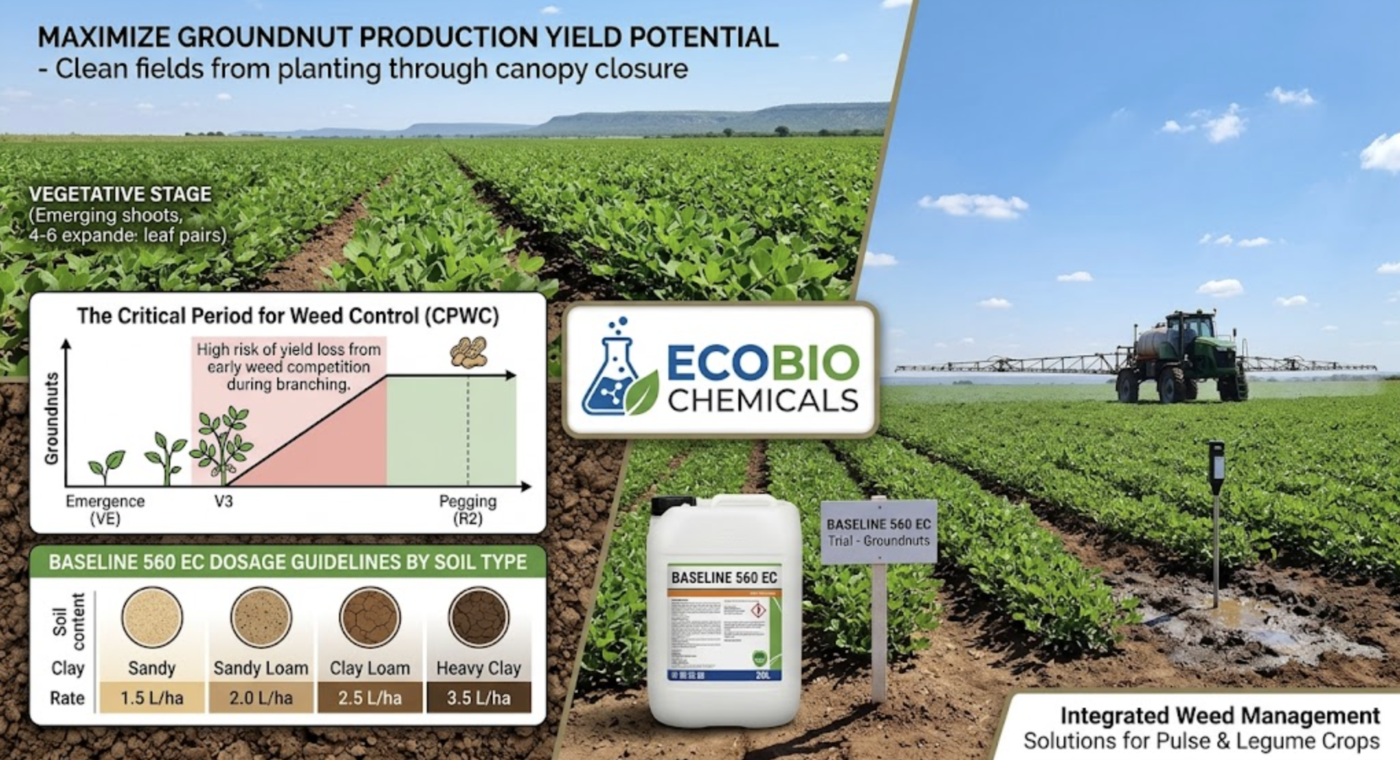
                   Critical Period for Weed Control (CPWC)
                           VE to Pegging Stage (V4-V6)
  ┌─────────────────────────────────────────────────────────────────────────────┐
  │                                                                             │
  │   Planting (VE) ─────────────► V3 Stage ─────────────► Pegging / Canopy     │
  │        │                                                      │             │
  │        └────────────── MAXIMUM YIELD REDUCTION RISK ──────────┘             │
  │                       (Yield reduction potential: 45% - 80%)                │
  └─────────────────────────────────────────────────────────────────────────────┘
When weed seed germination is left unchecked during the Critical Period for Weed Control (CPWC), several yield-limiting factors develop:
- Inhibition of Peg Formation: Thick broadleaf and grass mats create physical barriers at the soil surface, preventing emerging pegs (gynophores) from penetrating the soil to set pods.
- Nutrient & Water Depletion: Broadleaf weeds rapidly draw down profile moisture and mobile soil nutrients during early vegetative branching.
- Harvest Impairment: Late-season weed persistence entangles lifting equipment, breaks pods off from stems, and increases pod rot by trapping humidity near the soil surface.
Efficacy of a Selective Pre-Emergence Spray
Applying a selective pre-emergence spray immediately after planting creates an uninterrupted chemical layer in the upper 2-5 cm of the soil profile. This barrier destroys germinating weed seedlings before they breach the surface while maintaining crop safety for the emerging groundnut hypocotyl.
Baseline 560 EC utilizes a complementary dual active formulation:
- Acetochlor (348 g/L): A Group 15 Very Long Chain Fatty Acid (VLCFA) inhibitor that stops cell division in germinating weed shoots and root tips.
- Terbuthylazine (212 g/L): A Group 5 Photosystem II (PSII) inhibitor that enters weed root systems, blocking photosynthetic electron transport as weeds attempt emergence.
Together, these active ingredients offer broad-spectrum residual control, preventing early weed flushes without delaying legume seedling emergence.
Product Technical Specifications
Chemical Formulation & Packaging Properties
| Parameter | Technical Specification |
| Product Name | Baseline 560 EC |
| Formulation Type | Emulsifiable Concentrate (EC) |
| Active Ingredients | Acetochlor (348\ g/L) + Terbuthylazine (212 g/L) |
| HRAC Group Code | Group 15 (K3) + Group 5 (C1) |
| Target Crops | Groundnuts, Soybeans, Dry Beans, Maize, Sugarcane |
| Standard Packaging | 5L and 20L High-Density Polyethylene (HDPE) Containers |
| Mode of Action | Systemic pre-emergence absorption via germinating roots and shoots |
Dosage Guidelines by Soil Clay Percentage
To balance maximum weed suppression with optimal crop safety, adjust application rates strictly according to soil texture and clay fraction:
| Soil Classification | Clay Fraction | Dosage Rate (L/ha) | Carrier Water Volume (L/ha) |
| Light / Sandy | 0%-10% Clay | 1.5 L/ha | 100-200L |
| Sandy Loam | 11%-20% Clay | 2.0 L/ha | 100-200L |
| Clay Loam | 21%-35% Clay | 2.5 L/ha | 150-250L |
| Heavy Clay | > 35% Clay | 3.0 L/ha | 150-300L |
Precautions: On light, sandy soils (<10% clay) with low organic matter content (<1%), ensure groundnut seed is planted at correct depth to prevent chemical contact with germinating seeds during heavy rainfall.
Target Weed Spectrum Controlled
Baseline 560 EC offers complete early suppression across common agricultural weed species in legume production:
Annual Grasses
- Crabgrass (Digitaria sanguinalis)
- Goosegrass (Eleusine indica)
- Foxtails (Setaria spp.)
- Signal grass (Urochloa spp.)
Broadleaf Weeds
- Pigweed / Amaranth (Amaranthus spp.)
- Black nightshade (Solanum nigrum)
- Common goosefoot (Chenopodium album)
- Khaki weed (Tagetes minuta)
Field Application Protocols for Groundnut Cultivation
Adhere to key agronomic practices to optimize groundnut farming chemicals for safety and weed control efficiency:
Seedbed Quality & Preparation
Prepare a smooth, firm, and uniform seedbed free of large clods and crop residues. Heavy clods shield weed seeds from spray droplets, creating gaps in the chemical barrier where weeds can escape.
Seed Placement & Depth
Plant groundnut seeds at a uniform depth of 40-50mm. Adequate planting depth places the sensitive hypocotyl below the herbicide incorporation layer, preventing crop injury during radicle elongation.
Moisture Activation Window
Soil-active pre-emergence herbicides require soil moisture for activation. Ensure 10-15mm of rainfall or light overhead center-pivot irrigation occurs within 7 to 10 days post-application to move active ingredients into the primary weed seed germination zone 2-3 cm below the surface).
Tank Mixing & Spraying Setup
Maintain constant hydraulic or mechanical agitation inside the spray tank during field runs. Utilize flat-fan spray nozzles (e.g., standard 110° flat fan or air-induction nozzles) operated at 2-3 bar pressure to deliver medium-to-coarse droplet distribution across the soil bed.
Applying Baseline 560 EC within a comprehensive weed management program secures clean rows, supports unobstructed pegging, and preserves maximum yield potential in commercial groundnut production.