
Baseline 560 EC
Baseline 560 EC – Tank-Mixing Best Practices:
Aug
What Can You Mix with Baseline 560 EC Safely?
Tank-mixing multiple plant protection products in a single spray pass saves time, reduces field traffic, and lowers operational fuel costs. However, mixing incompatible agricultural chemicals can cause severe issues, ranging from physical precipitation which clogs spray nozzles to reduced weed control and severe crop foliage burn.
Baseline 560 EC is a dual-action pre-emergence emulsifiable concentrate containing Acetochlor (348 g/L) and Terbuthylazine (212 g/L). While highly effective on its own, maximizing its potential requires strict adherence to agricultural tank mixing rules, careful testing for herbicide compatibility, and implementation of practical farm chemical mixing tips.
Core Principles of Agricultural Tank Mixing
Before combining any secondary product with Baseline 560 EC, applicator crews must understand the chemical dynamics at play within the spray tank.
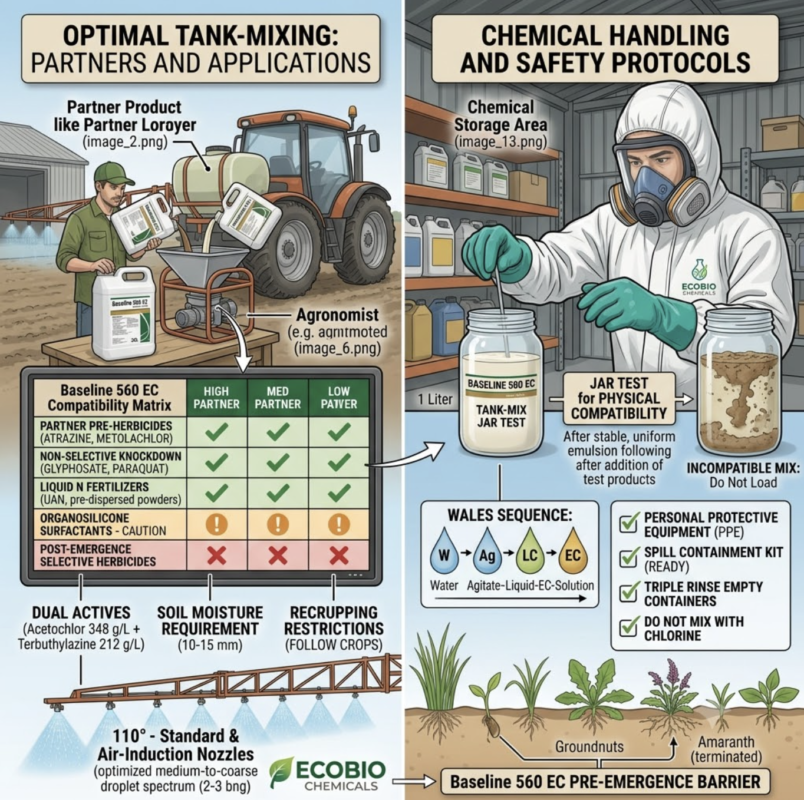
                      Standard Tank-Mixing Order (WALES)
  ┌─────────────────────────────────────────────────────────────────────────────┐
  │                                                                             │
  │  W ──► Water-Soluble Packaging & Wettable Powders (WP, WDG)                 │
  │  A ──► Agitate & Ensure Complete Dispersion                                 │
  │  L ──► Liquid Flowables & Suspension Concentrates (SC, SE)                  │
  │  E ──► Emulsifiable Concentrates ──► ADD BASELINE 560 EC                    │
  │  S ──► Solutions & Surfactants / Adjuvants (SL, EC Adjuvants)              │
  │                                                                             │
  └─────────────────────────────────────────────────────────────────────────────┘
Adding products in the wrong sequence can break emulsifiers, cause active ingredients to precipitate out of solution, or form a heavy sludge at the bottom of the spray tank.
Baseline 560 EC Compatibility Matrix
Baseline 560 EC is designed for broad compatibility with many common pre-emergence partner herbicides, liquid fertilizers, and specialist adjuvants. Always verify specific label recommendations prior to large-scale tank loading.
| Product Category | Compatibility Status | Approved Partners / Notes | Technical Considerations |
| Partner Pre-Emergence Herbicides | High | Atrazine, Mesotrione, Metolachlor, Pendimethalin | Expands broadleaf and grass control spectrum; monitor total triazine load. |
| Non-Selective Knockdown Herbicides | High | Glyphosate, Paraquat | Ideal for burn-down + residual pre-emergence combinations prior to planting. |
| Liquid Nitrogen Fertilizers | Moderate to High | UAN (Urea Ammonium Nitrate) carrier solutions | Requires pre-dispersion of powders in water before adding fertilizer carriers. |
| Organosilicone Surfactants | CAUTION | Select non-ionic surfactants | May increase crop penetration risk on light, sandy soils. |
| Post-Emergence Selective Herbicides | NOT RECOMMENDED | High-load foliar selective post-emergence sprays | Risk of severe foliar phytotoxicity due to EC solvent load. |
Essential Farm Chemical Mixing Tips & Procedures
Follow these step-by-step practices to ensure a smooth, stable spray mixture every time:
1. The Jar Test for Physical Compatibility
Always perform a small-scale jar test before mixing large batches in the field:
- Fill a clean 1-liter glass jar half full with water from the intended spray source.
- Add proportional amounts of each chemical following the WALES sequence.
- Cap the jar, shake vigorously for 30 seconds, and let sit for 15 minutes.
- Inspect the mixture: If you observe clumping, separation, flocs, or a heavy oily layer, the mixture is physically incompatible and should not be loaded into the sprayer.
2. Water Quality Parameters
- pH Level: Ensure spray water pH is maintained between 5.5 and 7.0. Highly alkaline water (> 8.0) accelerates alkaline hydrolysis, breaking down active ingredients like Terbuthylazine.
- Water Hardness: High calcium and magnesium levels can impair the emulsifiers in Baseline 560 EC. Use approved water conditioners if water hardness exceeds 300 ppm.
Technical Specifications & Mixing Sequence
| Mixing Parameter | Specification Standard |
| Primary Actives | Acetochlor (348 g/L) + Terbuthylazine (212 g/L) |
| Formulation Class | Emulsifiable Concentrate (EC) |
| Addition Point in Sequence | Add after SC formulations, before soluble liquids (SL) and surfactants |
| Agitation Requirement | Continuous mechanical or hydraulic agitation throughout mixing and spraying |
| Nozzle Compatibility | 110°C flat-fan or air-induction nozzles at 2 to 3 bar pressure |
Preventing Crop Injury During Tank-Mixing
Tank-mixing EC formulations with certain adjuvants or fertilizers can strip protective wax from emerging seedlings. To prevent crop damage:
- Avoid Oil-Based Adjuvants: Do not add crop oil concentrates (COC) or methylated seed oils (MSO) when mixing Baseline 560 EC with post-emergence burn-down products unless specifically directed by an agronomist.
- Check Soil Clay Content: Do not apply tank mixes containing Baseline 560 EC on coarse soils with less than 10% clay content to prevent root leaching.
- Flush Tank Promptly: Never leave Baseline 560 EC spray mixtures sitting in the tank overnight without continuous agitation.