
Uncategorized
Soil Types and Compatibility: Baseline 560 EC
Aug
Where and When NOT to Use Baseline 560 EC
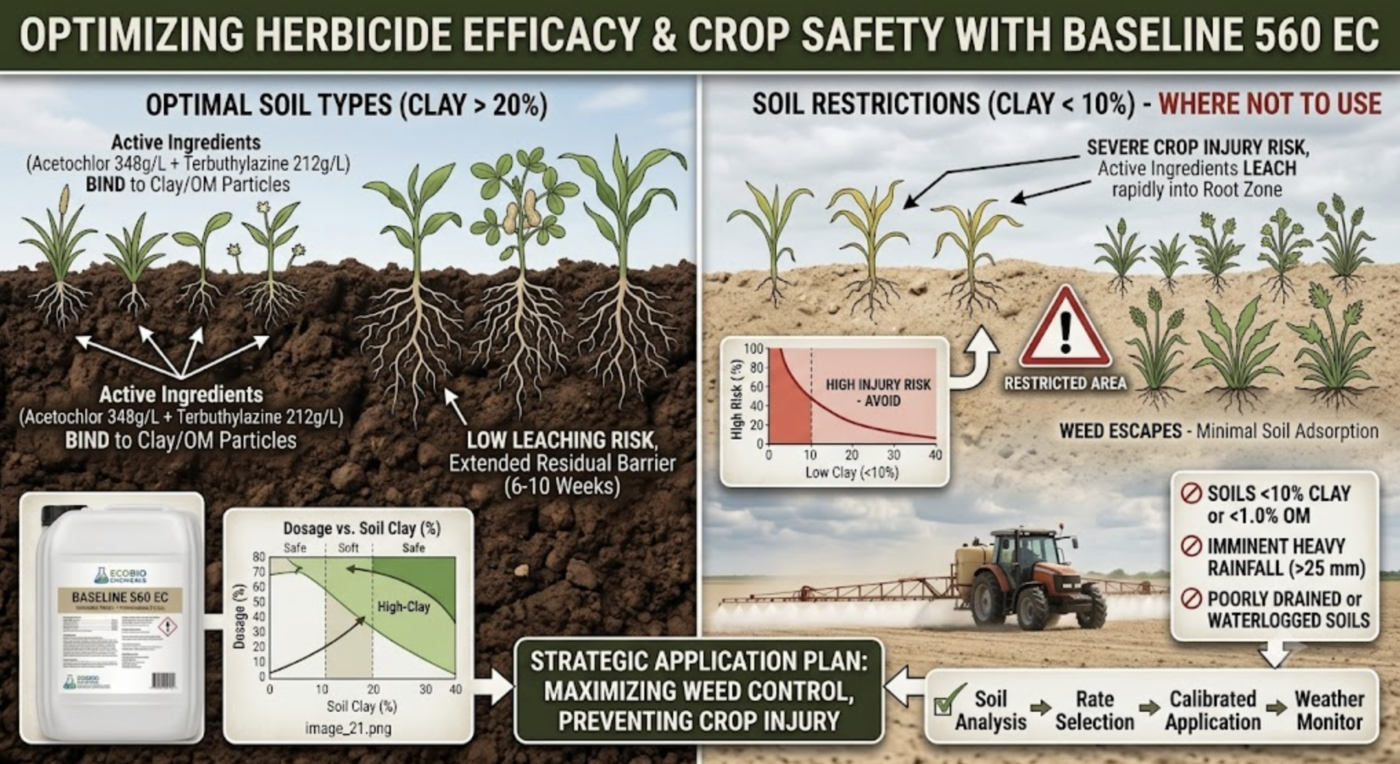
Achieving maximum weed control while ensuring crop safety requires a thorough understanding of soil dynamics. Baseline 560 EC is a dual-action pre-emergence herbicide containing Acetochlor (348 g/L) and Terbuthylazine (212 g/L). While highly effective at creating a multi-week soil barrier against competitive grasses and broadleaf weeds, its performance and safety depend heavily on soil texture, organic matter, and moisture levels.
Failing to evaluate soil conditions before application can lead to chemical leaching, reduced residual efficacy, or severe crop damage. Understanding key soil restrictions for herbicides, following precise sandy soil herbicide guidelines, and implementing proven strategies for crop injury prevention will keep your fields productive and safe.
How Soil Properties Affect Baseline 560 EC
The interaction between soil components and active ingredients determines how long an herbicide remains in the weed-germinating zone and whether it becomes concentrated enough to harm crop roots.
                      Soil Composition vs. Herbicide Behavior
  ┌─────────────────────────────────────────────────────────────────────────────┐
  │                                                                             │
  │ LOW CLAY / SANDY SOILS ────────► Fast Leaching ───► High Crop Injury Risk   │
  │ (Under 10% Clay)                                                            │
  │                                                                             │
  │ OPTIMAL CLAY LOAM ─────────────► Soil Binds Active ─► Extended Residual &    │
  │ (15% to 35% Clay)                Ingredients          Crop Safety           │
  │                                                                             │
  │ HEAVY CLAY / HIGH ORGANIC ─────► High Adsorption ──► Requires Higher Rate   │
  │ (Over 35% Clay)                                                             │
  └─────────────────────────────────────────────────────────────────────────────┘
- Clay Content: Clay particles carry negative electrical charges that adsorb herbicide molecules. Higher clay percentages bind active ingredients, slowing down leaching and extending residual life.
- Organic Matter (OM): Organic matter acts like a sponge for soil-applied chemicals. High OM soils require adjusted dosage rates to achieve adequate weed control.
- Soil pH: Extreme pH levels can alter the solubility and degradation rate of active ingredients like Terbuthylazine, impacting persistence and crop safety.
Where NOT to Use Baseline 560 EC: Key Soil Restrictions
To avoid off-target movement and seedling phytotoxicity, adhere to the following strict soil restrictions:
| Soil / Field Condition | Compatibility Status | Technical Risk & Agronomic Impact |
| Coarse Sand / Pure Sand (<10% Clay) | DO NOT USE | High leaching potential; active ingredients wash rapidly into the crop root zone, causing severe seedling stunting. |
| Waterlogged / Poorly Drained Soils | DO NOT USE | Anaerobic conditions and standing water cause crop root stress and unpredictable chemical concentration. |
| Gravelly or Stony Soils | RESTRICTED | Uneven soil distribution leads to chemical pooling and localized crop damage. |
| Soils with <1.0% Organic Matter | DO NOT USE | Insufficient adsorption capacity increases free herbicide concentration in soil water. |
Sandy Soil Herbicide Guidelines
Coarse-textured soils present the highest risk of herbicide crop injury due to high hydraulic conductivity and low chemical adsorption capacity. If applying pre-emergence treatments in fields with variable soil texture, follow these guidelines:
- Verify Soil Clay Percentage: Always conduct a soil mechanical analysis prior to application. Do not apply Baseline 560 EC on soils containing less than 10% clay.
- Reduce Application Dosage on Light Soils: On sandy loams (10-15% clay), strictly adhere to lower label rates (1.5 L/ha) to prevent excess active concentration in the upper root zone.
- Manage Irrigation & Rainfall: Avoid heavy overhead irrigation (>25mm) immediately following application on light soils, as this drives the active ingredients past the shallow weed-germinating layer directly into germinating crop seeds.
Crop Injury Prevention & Application Limits
Preventing chemical injury requires matching sprayer calibration and field conditions to crop tolerance limits.
High-Risk Environmental Conditions
Avoid applying Baseline 560 EC under the following field conditions:
- Imminent Heavy Downpours: Rainfall exceeding 30mm within 24 hours of application can force the chemical barrier into direct contact with crop seed beds.
- Compacted or Cloddy Seedbeds: Poor soil preparation leaves open seed furrows where spray droplets land directly on exposed crop seeds.
- Cold, Wet Soil Conditions: Extended cold weather slows crop germination, keeping vulnerable crop shoots exposed to soil-applied actives for longer periods.
Application Specifications by Soil Type
| Soil Classification | Clay Percentage | Recommended Dosage Rate | Crop Safety Level |
| Coarse Sand / Light Sand | 0%-9% | Not Recommended / Prohibited | High Risk of Injury |
| Sandy Loam | 10%-20% | 1.5-2.0 L/ha | Safe with calibrated rates |
| Clay Loam | 21%-35% | 2.5-3.0 L/ha | High crop safety |
| Heavy Clay / High Organic | >35% | 3.0-3.5 L/ha | Excellent crop safety |