
Herbicides, Baseline 560 EC
Signs of weed pressure:
Aug
5 Signs Your Crop Fields Need a Pre-Emergence Herbicide Strategy Now
Implementing professional crop scouting helps identify key signs of weed pressure early, allowing growers to transition from reactive post-emergence treatments to a proactive pre-emergence protocol. Utilizing soil-applied chemistries like Baseline 560 EC (Acetochlor 348 g/L + Terbuthylazine 212 g/L) creates a continuous chemical barrier in the top soil zone, preventing weed emergence and securing early crop vigor.
For broadacre producers, waiting until weeds are visible across the field means the damage is already underway. Early-season weeds compete aggressively with germinating crops for soil moisture, nitrogen, and sunlight during the critical initial weeks of growth.
The 5 Critical Warning Signs in Your Fields
Recognizing field indicators early allows commercial managers to adjust their chemical protocols before yield loss occurs.
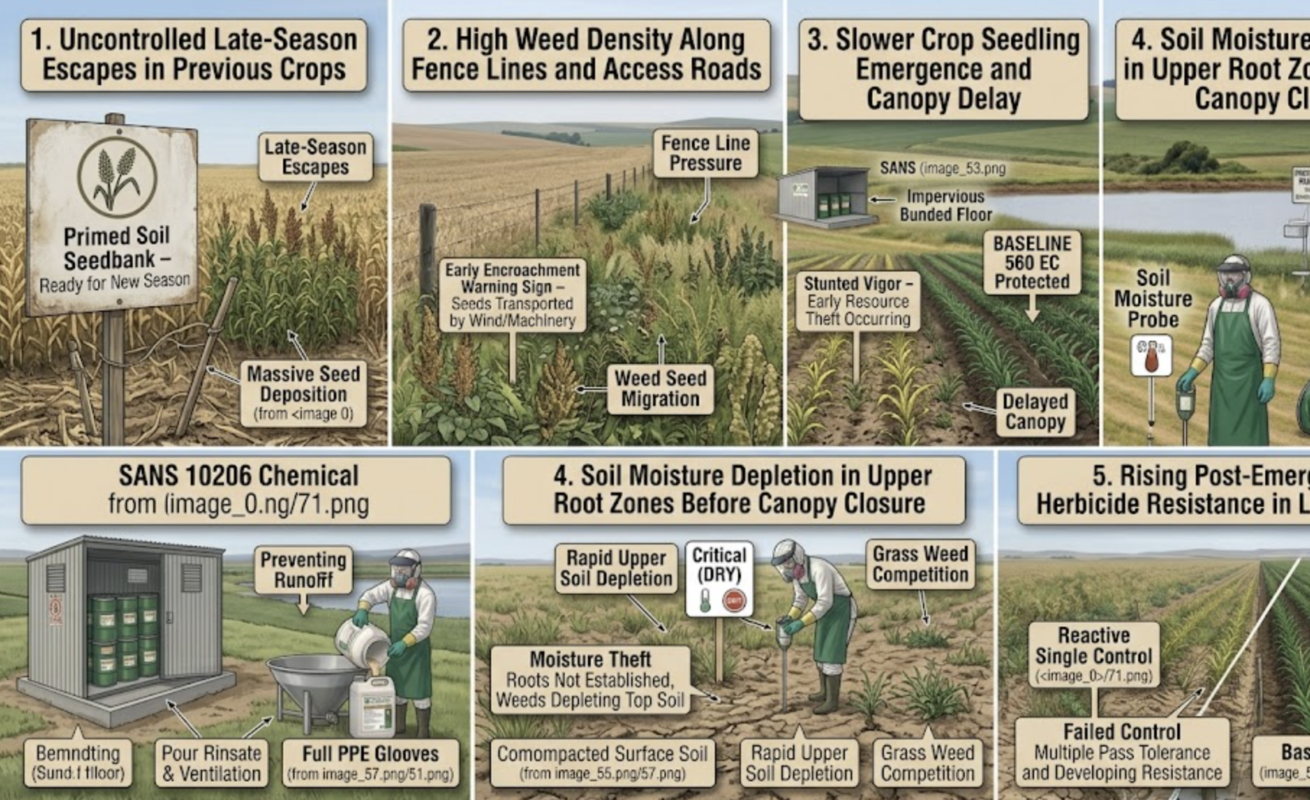
                    5 Warning Signs of Weed Pressure
  ┌─────────────────────────────────────────────────────────────────────────────┐
  │                                                                             │
  │  1. Uncontrolled Late-Season Escapes in Previous Crops                      │
  │  2. High Weed Density Along Fence Lines and Access Roads                    │
  │  3. Slower Crop Seedling Emergence and Canopy Delay                         │
  │  4. Soil Moisture Depletion in Upper Root Zones Before Canopy Closure       │
  │  5. Rising Post-Emergence Herbicide Resistance in Local Fields              │
  │                                                                             │
  └─────────────────────────────────────────────────────────────────────────────┘
1. Uncontrolled Late-Season Escapes in Previous Crops
If previous harvests left behind mature, seed-bearing weeds, your soil seedbank is heavily primed for the coming season. A single pigweed (Amaranthus) or broadleaf plant can deposit tens of thousands of viable seeds back into the soil matrix.
2. High Weed Density Along Fence Lines and Roadways
Field perimeters act as early indicators for incoming weed encroachment. Wind, livestock, and machinery transport seeds from boundary lines into arable crop land.
3. Slower Seedling Emergence and Stunted Vigor
When young crop plants struggle to establish uniform leaf growth, subterranean root competition from germinating weed seeds is often the culprit. Early resource theft happens beneath the surface before weeds fully emerge.
4. Rapid Upper Soil Moisture Depletion
If soil moisture drops rapidly in the top 20-30 mm of the seedbed during early summer without crop uptake, fast-germinating annual grass species are actively drawing down water reserves.
5. Reduced Efficacy of Post-Emergence Herbicide Passes
Experiencing patchy control or needing higher spray rates to burn back broadleaf escapes indicates developing weed resistance. Shifting to dual-active pre-emergence chemistries resets control efficiency.
Strategic Shift: Reactive vs. Pre-Emergent Control
| Field Scenario | Reactive Post-Emergence Protocol | Proactive Pre-Emergence Strategy (Baseline 560 EC) |
| Application Timing | After weeds reach 3–6 leaf stage | At planting or immediately post-plant |
| Early Yield Protection | Low (crop suffers 14–21 days of competition) | High (100% protection during critical 30-day window) |
| Pass Frequency | Multiple follow-up passes required | Single consolidated soil-barrier application |
| Resistance Profile | High risk from single-mode post-sprays | Low risk via Acetochlor + Terbuthylazine dual active |
On-Farm Chemical Storage, Handling & Environmental Compliance
Integrating Baseline 560 EC into your farm workflow requires strict adherence to chemical storage regulations, enforcing protocols for the safe disposal of pesticide containers, and taking active measures for preventing runoff.
                   Compliant Agrochemical Safety Framework
  ┌─────────────────────────────────────────────────────────────────────────────┐
  │                                                                             │
  │  [✓] SANS 10206 Store (110% Capacity Concrete Bund Retaining Wall)          │
  │  [✓] Complete PPE (OV Respirator, Nitrile Gauntlets, PVC Apron & Goggles)   │
  │  [✓] Environmental Safety (Maintain Grassed Buffer Strips & Water Checks)   │
  │  [✓] Certified Recycling (Triple-Rinse, Puncture Drum & Route to CropLife)  │
  │                                                                             │
  └─────────────────────────────────────────────────────────────────────────────┘
- Storage Compliance (SANS 10206): Store chemicals in a lockable, cross-ventilated room featuring an impervious concrete floor and a 200 mm bund wall capable of holding 110% of total stored liquid volume.
- Herbicide Safety Gear: Operators handling emulsifiable concentrate (EC) formulations must wear chemical-resistant 14 + mil nitrile gauntlet gloves, heavy PVC aprons, chemical splash goggles, and half-mask respirators with Organic Vapor (OV) cartridges to ensure complete farm worker chemical safety.
- Container Disposal & Runoff Mitigation: Triple-rinse empty 5L and 20L drums immediately after emptying, pour rinsate into the spray tank, puncture the base to prevent secondary reuse, and route plastic to an accredited CropLife SA collector. Maintain vegetated filter strips near dams and waterways to prevent chemical runoff during heavy summer rains.