
Baseline 560 EC, Herbicides
Understanding Baseline 560 EC: Active Ingredients, Formulation, and Mode of Action
Aug
Baseline 560 EC is a commercial emulsifiable concentrate designed to establish a long-lasting, dual-action pre-emergence soil barrier across row-crop farming operations. Modern weed management in broadacre crop production relies on precise chemical mechanics to prevent yield-robbing weed competition before seedlings emerge above the soil line.
Evaluating the chemical specs, biochemical pathways, and structural mechanics of this acetochlor terbuthylazine herbicide enables agronomists and farm managers to optimize application timing while proactively managing weed resistance.
Active Ingredient Breakdown & Formulation Specs
Baseline 560 EC combines two complementary active ingredients from distinct chemical families, delivering broad-spectrum control against annual grasses and target broadleaf weeds.
| Technical Parameter | Acetochlor Component | Terbuthylazine Component |
| Chemical Family | Chloroacetamide (Chloroacetanilide) | Triazine |
| HRAC / WSSA Group | Group 15 (Legacy Group K3) | Group 5 (Legacy Group C1) |
| Target Weed Spectrum | Annual grasses & yellow nutsedge suppression | Broadleaf weeds & select annual grasses |
| Primary Plant Uptake | Emerging shoots (coleoptiles) and young roots | Plant roots and developing foliage |
| Formulation Type | Emulsifiable Concentrate (EC) | Emulsifiable Concentrate (EC) |
Pre-Emergence Weed Killer Mode of Action & Biochemical Pathways
Understanding the pre-emergence weed killer mode of action requires examining how each active ingredient interferes with plant cell physiology during seed germination.
                    Dual Mechanism of Action in Seedlings
  ┌─────────────────────────────────────────────────────────────────────────────┐
  │                                                                             │
  │  ACETOCHLOR (Group 15)   ──► Inhibits Very Long Chain Fatty Acids (VLCFAs)  │
  │                              └─► Blocks Cell Division & Membrane Formation  │
  │                                                                             │
  │  TERBUTHYLAZINE (Group 5) ──► Inhibits Photosystem II (PSII) Electron Transport
  │                              └─► Induces Oxidative Stress & Tissue Necrosis │
  │                                                                             │
  └─────────────────────────────────────────────────────────────────────────────┘
- Group 15 Mechanics (Acetochlor): Acetochlor inhibits the synthesis of Very Long Chain Fatty Acids (VLCFAs) in germinating seedlings. By disrupting lipid biosynthesis, it prevents cell division and elongation in emerging roots and shoots. Sensitive grass seedlings absorb the chemical primarily through the coleoptile as they push through the treated soil layer, causing seedling death before emergence.
- Group 5 Mechanics (Terbuthylazine): Terbuthylazine binds to the
D1 protein in Photosystem II (PSII), halting photosynthetic electron transport. This block causes an accumulation of reactive oxygen species (ROS) within plant cells, damaging cell membranes and leading to severe chlorosis and necrosis once seedlings attempt photosynthesis upon light exposure.
Why Dual-Active Formulations Delay Weed Resistance
Relying on single-site herbicides creates heavy selection pressure, accelerating the evolution of resistant weed biotypes. Combining chloroacetamide and triazine chemistries in Baseline 560 EC provides key agronomic advantages:
- Complementary Target Sites: A weed seedling that possesses metabolic tolerance or target-site mutation against Group 15 chemistries is controlled by the Group 5 active ingredient, and vice versa.
- Extended Residual Synergy: Acetochlor delivers immediate root/shoot absorption during germination, while Terbuthylazine provides stable soil persistence, maintaining continuous chemical barrier integrity in the top 20-30 mm of soil.
- Broadened Spectrum Control: Grasses and broadleaf weeds are targeted simultaneously, eliminating the need for complex, unproven tank-mix combinations.
On-Farm Chemical Storage, Handling & Environmental Safety Standards
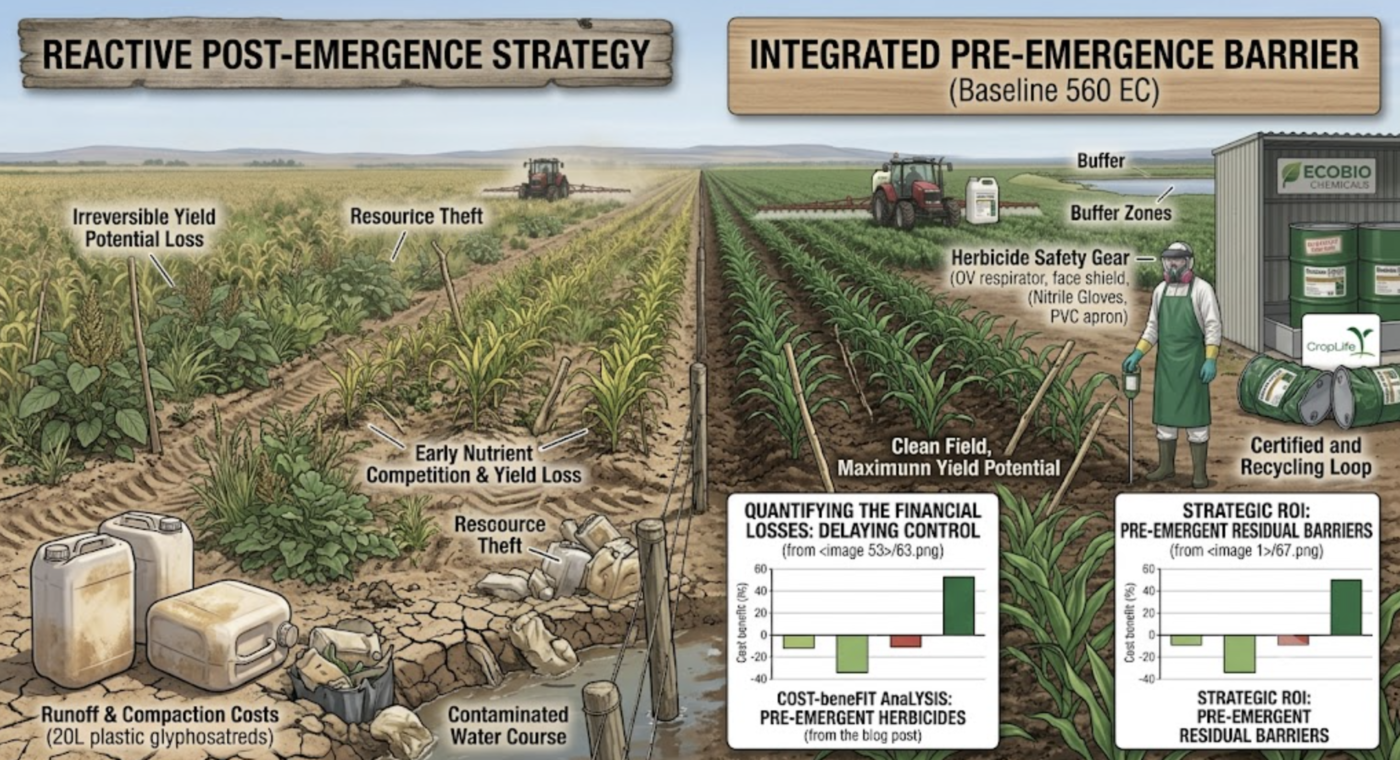
Managing Baseline 560 EC active ingredients safely requires strict adherence to chemical storage regulations, enforcing protocols for the safe disposal of pesticide containers, and active measures for preventing runoff.
                   Compliant Agrochemical Stewardship Loop
  ┌─────────────────────────────────────────────────────────────────────────────┐
  │                                                                             │
  │  [✓] Store Compliance (SANS 10206 - 110% Capacity Concrete Bunding)         │
  │  [✓] Personal Safety (OV Respirator, Nitrile Gauntlets, PVC Apron & Goggles)  │
  │  [✓] Environmental Safety (Maintain Grassed Buffer Strips & Water Checks)   │
  │  [✓] Certified Recycling (Triple-Rinse, Puncture Drum & Route to CropLife)  │
  │                                                                             │
  └─────────────────────────────────────────────────────────────────────────────┘
- Storage Compliance (SANS 10206): Store emulsifiable concentrates in a secure, lockable chemical room featuring cross-ventilation, smooth non-porous concrete flooring, and a 200 mm bund wall capable of holding 110% of total stored liquid volume.
- Herbicide Safety Gear: Operators handling concentrated EC liquids must wear chemical-resistant 14 + mil nitrile gauntlet gloves, heavy PVC aprons, chemical splash goggles, and half-mask respirators with Organic Vapor (OV) cartridges to maintain complete farm worker chemical safety.
- Container Disposal & Runoff Mitigation: Triple-rinse empty 5L and 20L containers immediately after use, pour rinsate into the spray tank, puncture the base to prevent reuse, and transfer plastic to an accredited CropLife SA recycling collector. Maintain vegetated filter strips near streams and dams to prevent chemical runoff during heavy summer rainfall.