
Silver mercury
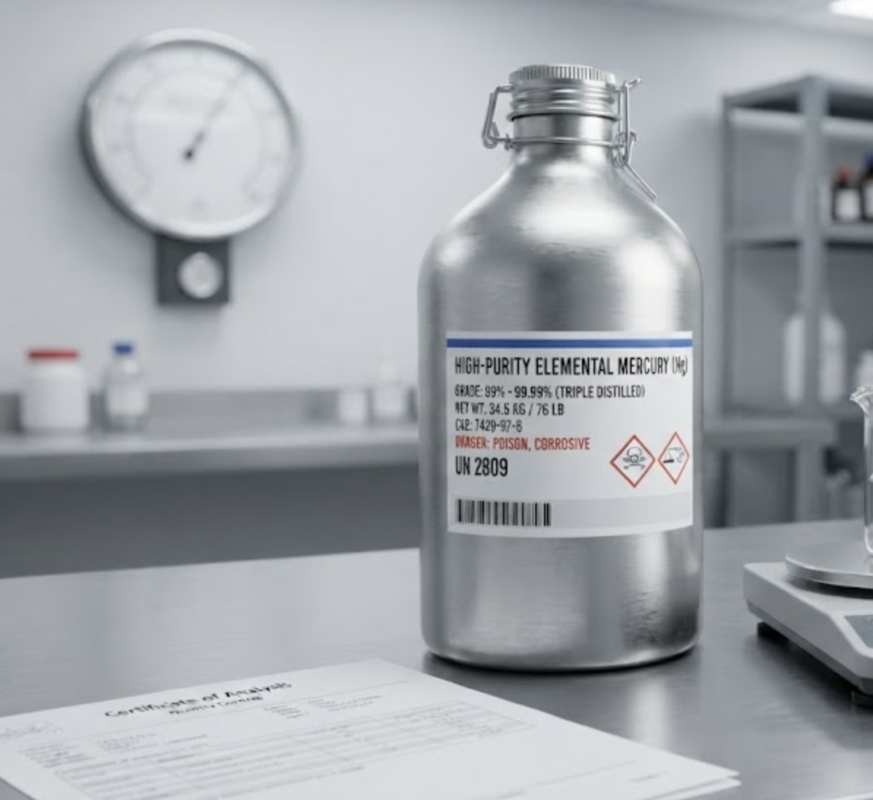
Why Choose 99% Purity Mercury (Triple-Distilled) for Industrial and Scientific Applications
Oct
The Critical Importance of Purity: 99% (Triple-Distilled) Mercury
In the specialized fields of advanced manufacturing, scientific research, and precision instrumentation, the quality of raw materials is not merely a consideration; it is the foundation of operational success. While various grades of elemental mercury (Hg) exist, specifying 99% purity mercury—frequently designated as triple-distilled is essential for applications demanding the highest levels of reliability, accuracy, and safety.
This post explores why choosing high-purity mercury is a non-negotiable standard for critical industries and how it directly impacts performance and regulatory compliance.
1. Precision in Instrumentation and Metrology
Mercury’s unique physical properties – specifically its high density and uniform thermal expansion—make it the benchmark fluid for calibration and measurement. However, even trace impurities can alter these properties, leading to significant measurement errors.
- Barometers and Manometers: For meteorological stations, refineries, and aerospace laboratories, barometric pressure readings must be accurate to minute fractions. Impurities in mercury can affect its surface tension and density, causing inaccurate meniscus formation and erroneous readings.
- Calibration Standards: High-purity mercury is the required medium for calibrating pressure transducers and other high-stakes measurement devices. Using anything less than 99% purity introduces variables that compromise the entire calibration chain.
2. Reliability in Electrical and Mechanical Switching
While mercury use in consumer products has declined, it remains indispensable in heavy-duty, specialized industrial relays, tilt switches, and motion sensors. In these applications, the mercury must complete an electrical circuit cleanly and reliably millions of times.
- Prevention of Oxidation and Fouling: Lower purity mercury contains metallic contaminants (such as lead, copper, or zinc) that can oxidize over time. These oxides form sludge or films on the mercury’s surface, leading to increased electrical resistance, erratic switching behavior, and premature component failure.
- Consistent Conductivity: Triple-distilled mercury maintains consistent electrical conductivity throughout its operational lifespan, ensuring fail-safe performance in critical infrastructure such as power grid control systems and railway signaling.
3. Performance in Analytical Chemistry and Electrochemistry
Analytical laboratories rely on high-purity mercury for highly sensitive chemical analyses.
- Dropping Mercury Electrodes (DME): In polarography, a technique used for trace metal analysis, the purity of the mercury electrode is paramount. Impurities can cause background noise, interfere with the electrochemical reaction being measured, and mask the presence of the very substances the laboratory is trying to detect.
- Reagent Purity: Mercury is used in the preparation of specific analytical reagents. Contaminants in the mercury would be transferred to the reagent, invalidating sensitive experiments and research data.
4. Regulatory Compliance and Safety Assurance
Procuring 99% triple-distilled mercury is intrinsically linked to responsible sourcing and safety management.
- Certified Purity: High-purity mercury is supplied with a detailed Certificate of Analysis (CoA). This document verifies that the material meets precise impurity thresholds, which is crucial for meeting internal quality control standards and external regulatory audits.
- Traceability: Reputable suppliers of high-purity mercury provide full supply chain traceability, ensuring the material has been sourced, refined, and transported in compliance with international agreements like the Minamata Convention on Mercury.
Conclusion
Choosing 99% purity (triple-distilled) mercury is a strategic decision that prioritizes accuracy, reliability, and safety. While lower grades may offer short-term cost savings, the risks associated with instrumentation failure, inaccurate data, and regulatory non-compliance far outweigh the initial expense. For critical applications, purity is the only true economy.
Tags:
triple distilled mercury 99.99% purity, elemental mercury CAS 7439-97-6, high purity liquid quicksilver, industrial grade mercury for sale, mercury suppliers for scientific instruments, regulated heavy metal reagents, mercury for manometers and barometers, how is mercury purified (triple distillation), mercury Certificate of Analysis (CoA), Minamata Convention compliant mercury