
Baseline 560 EC
Pre-Emergence vs. Post-Emergence Herbicides: Why Choose Baseline 560 EC?
Aug
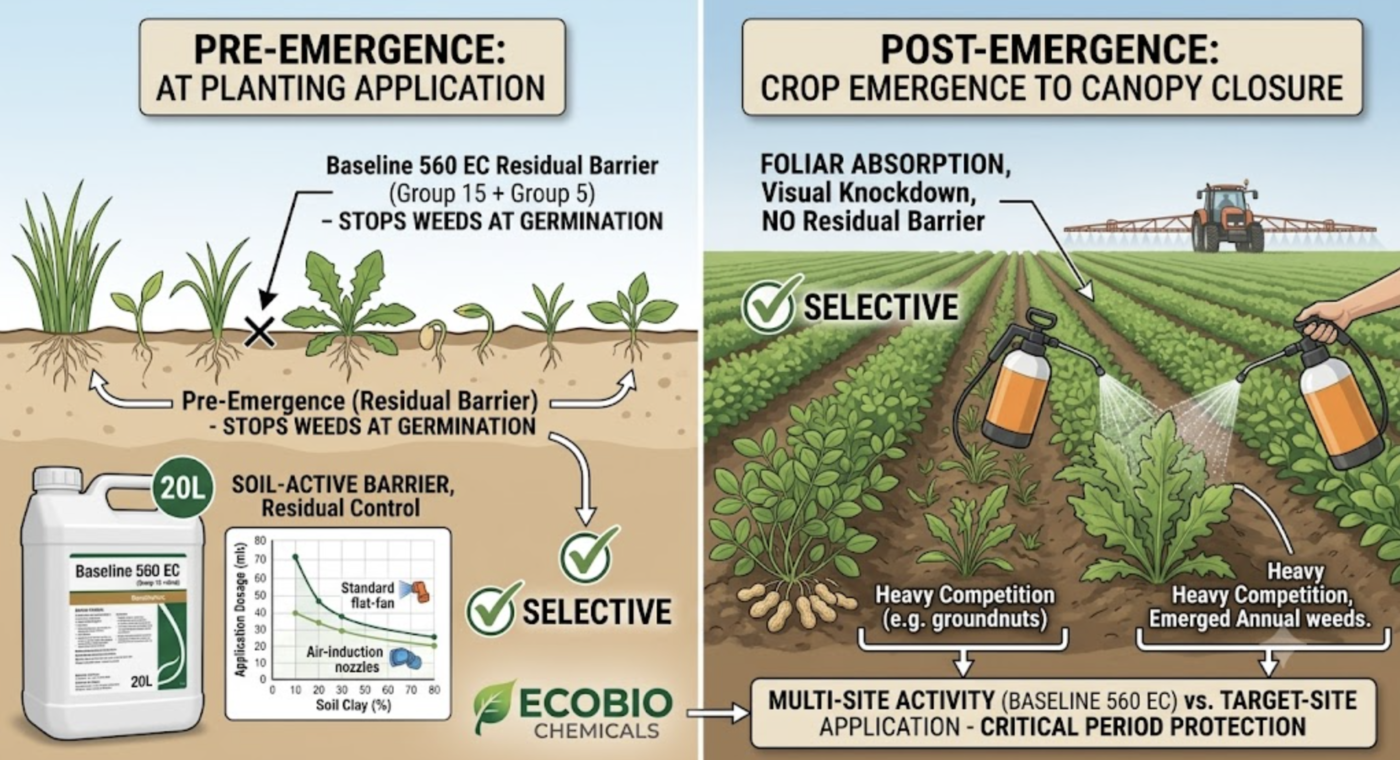
Baseline 560 EC – Managing aggressive weed pressure requires a strategic approach to timing and chemical selection. Farmers often face a key decision: target germinating weed seeds before they break through the ground, or treat active foliage after weeds have already established. Understanding the key differences between pre-emergence vs post-emergence control is essential for protecting crop yields and maximizing input efficiency. Incorporating Baseline 560 EC into your weed management program establishes a residual barrier that keeps fields clean during critical early growth stages.
Understanding Weed Control Timing
Choosing when to use selective herbicides depends on the crop’s development stage and the specific weed species present in the field.
                      Weed Control Application Timing
  ┌─────────────────────────────────────────────────────────────────────────────┐
  │                                                                             │
  │ Planting ───► Baseline 560 EC (Pre-Emergence Barrier) ───► Crop Emergence   │
  │                     │                                                       │
  │                     └────────► STOPS WEEDS AT GERMINATION                   │
  │                                                                             │
  │ Crop Emergence ───────────────────────────────────────────► Foliar Spray    │
  │                                                               (Post-Emergent)│
  └─────────────────────────────────────────────────────────────────────────────┘
- Pre-Emergence Herbicides: Applied to the soil surface before weed seeds germinate or emerge. They form a chemical barrier in the upper soil layer, inhibiting seedling root or shoot development.
- Post-Emergence Herbicides: Applied directly to actively growing foliage after weeds have emerged. They require direct foliar contact and absorption to disrupt plant physiological processes.
Key Differences: Pre-Emergence vs. Post-Emergence
While post-emergence sprays address immediate visual infestations, relying solely on post-emergence treatment allows early-season weeds to compete with emerging crops for water, light, and nutrients.
| Feature / Metric | Pre-Emergence (Baseline 560 EC) | Post-Emergence Herbicides |
| Application Window | Planting up to pre-crop emergence | Active weed growth post-emergence |
| Primary Target | Germinating seeds & shoot tissues | Active leaf canopy and stems |
| Yield Protection | Prevents early-season weed competition | Stops further damage after competition starts |
| Residual Activity | Provides multi-week soil residual control | Minimal to no soil residual activity |
| Weather Dependency | Requires soil moisture for activation | Requires rain-free window for leaf absorption |
Why Choose Baseline 560 EC?
Baseline 560 EC provides foundational weed control by combining two complementary modes of action into a high-performance soil-applied formulation:
- Acetochlor ($348\ g/L$): A Group 15 VLCFA synthesis inhibitor that prevents cell division in germinating annual grasses and small-seeded broadleaf weeds.
- Terbuthylazine ($212\ g/L$): A Group 5 Photosystem II (PSII) inhibitor absorbed via seedling roots, delivering strong residual control over competitive broadleaf species.
By stopping weeds before they emerge, Baseline 560 EC eliminates early root competition, allowing crops like groundnuts, maize, and pulse crops to establish uniform stands without chemical burn or competition stress.
Technical Specifications & Application Parameters- Why Choose Baseline 560 EC?
For optimal pre-emergence performance, application rates for Baseline 560 EC must be adjusted based on soil clay content:
| Parameter | Specification Details |
| Active Ingredients | Acetochlor (348 g/L) + Terbuthylazine (212 g/L) |
| Formulation Type | Emulsifiable Concentrate (EC) |
| HRAC Group Classification | Group 15 + Group 5 |
| Light/Sandy Soil Rate | 1.5%-10% Clay) |
| Sandy Loam Rate | 2.0%-20% Clay) |
| Clay Loam Rate | 2.5-3.0 L/ha (21%-35% Clay) |
| Heavy Clay Rate | 3.0-3.5 L/ha (>35% Clay) |
| Spraying Calibration | 110°C flat-fan or air-induction nozzles at 2 to 3 bar pressure |
Agronomic Best Practices for Baseline 560 EC
To ensure maximum residual efficacy and crop safety when applying Baseline 560 EC:
- Fine Seedbed Preparation: Ensure a smooth, uniform soil surface free of large clods or excessive crop residue to allow proper soil sealing.
- Moisture Activation: Baseline 560 EC requires 10-15 mm of rainfall or overhead irrigation within 7 to 10 days of application to activate the residual barrier in the seed germinating zone.
- Correct Spray Droplet Size: Use 110°C flat-fan or air-induction nozzles operated at 2 to 3 bar pressure to deliver a medium-to-coarse droplet spectrum across the soil bed.