
Baseline 560 EC
Baseline 560 EC – Understanding Residual Weed Control:
Aug
How Long Does Baseline 560 EC Last in Soil?
Early-season weed competition can severely reduce crop yields during critical emergence stages. Establishing an uninterrupted soil chemical barrier protection plan keeps fields clean while seedlings establish their root systems. Commercial growers relying on soil-applied active ingredients need precise data on how long chemical barriers remain active.
Understanding the mechanics of residual herbicide effect and specifically how long Baseline 560 EC stays active in the root zone is essential for optimizing application timing, preventing weed escapes, and planning safe seasonal crop rotations.
What Is Residual Weed Control?
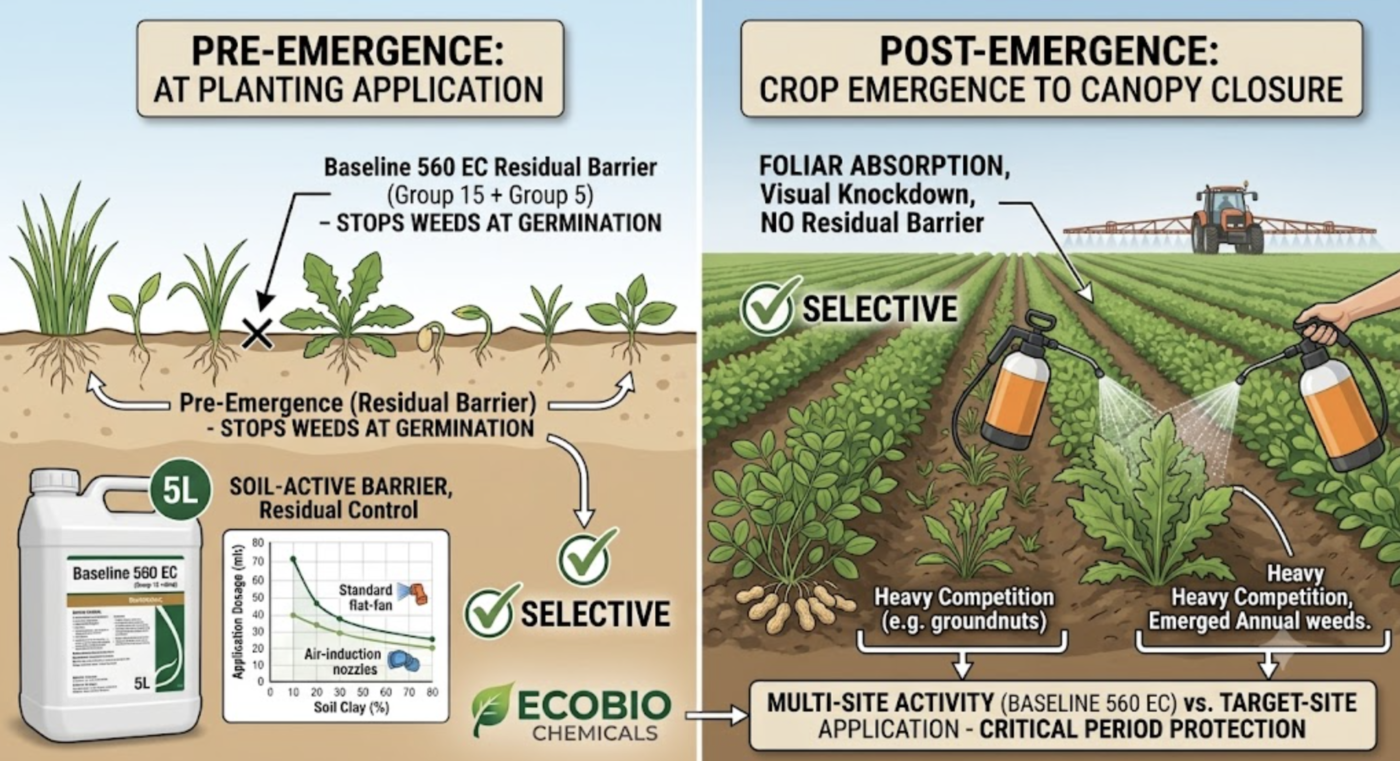
Residual weed control refers to the period during which a soil-applied herbicide remains active in the upper layer of soil to inhibit seed germination or seedling growth. Unlike contact foliar sprays that kill existing foliage on impact, residual herbicides form a protective layer across the soil profile.
                      Residual Protection Window
  ┌─────────────────────────────────────────────────────────────────────────────┐
  │                                                                             │
  │ Planting ──► Baseline 560 EC Applied ──► Active Soil Barrier (6-10 Weeks)   │
  │                     │                            │                          │
  │                     ▼                            ▼                          │
  │              Blocks Seedlings             Canopy Closure                    │
  │              at Germination               Prevents New Weeds                │
  │                                                                             │
  └─────────────────────────────────────────────────────────────────────────────┘
When weed seeds attempt to germinate within this treated zone, they absorb the chemical active ingredients through their developing roots or emerging shoots, terminating seedling growth before the plant breaks the surface.
How Long Does Baseline 560 EC Last in Soil?
Under standard field conditions, Baseline 560 EC delivers effective residual weed suppression for 6 to 10 weeks post-application.
This multi-week protection window covers the critical period for weed competition (CPWC) across key broadacre crops, ensuring the crop reaches full canopy closure before residual activity dissipates.
Dual Active Breakdown & Degradation Pathways
Baseline 560 EC achieves its extended soil residual profile through two complementary active ingredients:
- Acetochlor (348 g/L): Provides primary pre-emergence activity against annual grasses and select broadleaf weeds. Acetochlor binds moderately to soil organic matter and degrades primarily via microbial activity. Its typical soil half-life (DT50) ranges from 14 to 30 days, providing aggressive early-stage residual defense.
- Terbuthylazine (212 g/L): Delivers robust broad-spectrum residual control against broadleaf species. Terbuthylazine exhibits higher persistence in the upper soil profile, with a half-life (DT50) ranging from 30 to 60 days depending on soil temperature and microbial dynamics.
Together, this dual-component formulation ensures rapid initial shoot uptake alongside sustained root absorption over an extended operational window.
Factors Influencing Soil Residual Duration
The exact longevity of the residual herbicide effect varies across different fields based on localized environmental and agronomic factors.
| Soil / Environmental Factor | Impact on Baseline 560 EC Longevity | Technical Explanation |
|---|---|---|
| Soil Clay Percentage | High Impact | Higher clay and organic matter content bind active ingredients, extending residual life. Low clay soils experience faster chemical breakdown. |
| Soil Moisture & Rainfall | Moderate to High Impact | Requires 10–15 mm of moisture for soil activation. Excessive rainfall/flooding accelerates leaching below the germinating zone. |
| Soil Temperature | Moderate Impact | Warm, moist soils accelerate microbial degradation, reducing half-life compared to cool, dry soil conditions. |
| Tillage & Soil Disturbance | High Impact | Mechanical cultivation breaks the continuous soil chemical barrier protection, allowing weed escapes in turned soil. |
Technical Specifications and Dosage by Soil Type
To maintain the optimal 6-to-10-week residual window without risking crop phytotoxicity or excess carryover, Baseline 560 EC dosage rates must match soil texture:
| Soil Classification | Clay Percentage Range | Recommended Dosage Rate | Spray Volume (Water) |
|---|---|---|---|
| Light / Sandy Soils | 0%–10% Clay | 1.5 L/ha | 150–200 L/ha |
| Sandy Loam | 11%–20% Clay | 2.0 L/ha | 150–200 L/ha |
| Clay Loam | 21%–35% Clay | 2.5–3.0 L/ha | 150–200 L/ha |
| Heavy Clay / Vertisols | >35% Clay | 3.0–3.5 L/ha | 200 L/ha |
Agronomic Best Practices for Maximizing Residual Efficacy
- Calibrate Sprayer Nozzles Correctly: Apply Baseline 560 EC using standard 110∘ flat-fan or air-induction nozzles operated at 2 to 3 bar pressure to deliver a medium-to-coarse droplet spectrum across the soil bed.
- Apply to Clean, Smooth Seedbeds: Ensure the soil surface is free of large clods and heavy weed residue so the spray coverage creates an unbroken chemical seal.
- Plan Follow-Up Plantings Responsibly: Observe recropping intervals (plant-back restrictions) for sensitive follow crops such as sunflowers, dry beans, or vegetables due to the extended soil persistence of Terbuthylazine.