
Uncategorized
Baseline 560 EC – Preventing Herbicide Resistance:
Aug
Rotation Strategies with Baseline 560 EC
Repeated reliance on a single mode of action poses a critical threat to long-term crop protection strategies. As aggressive weed species rapidly develop resistance to common post-emergence herbicides, commercial growers must adopt proactive resistance management frameworks. Integrating Baseline 560 EC into structured crop rotation programs provides the multi-site pre-emergence activity required to break weed life cycles, delay target-site mutations, and preserve chemical efficacy across seasonal rotations.
Understanding Herbicide Resistance Mechanisms
Herbicide resistance occurs when a weed population naturally selects for biotypes capable of surviving a chemical dose that would normally control the species. Over-reliance on single-site chemistry such as glyphosate (Group 9) or ALS inhibitors (Group 2) accelerates this selection pressure.
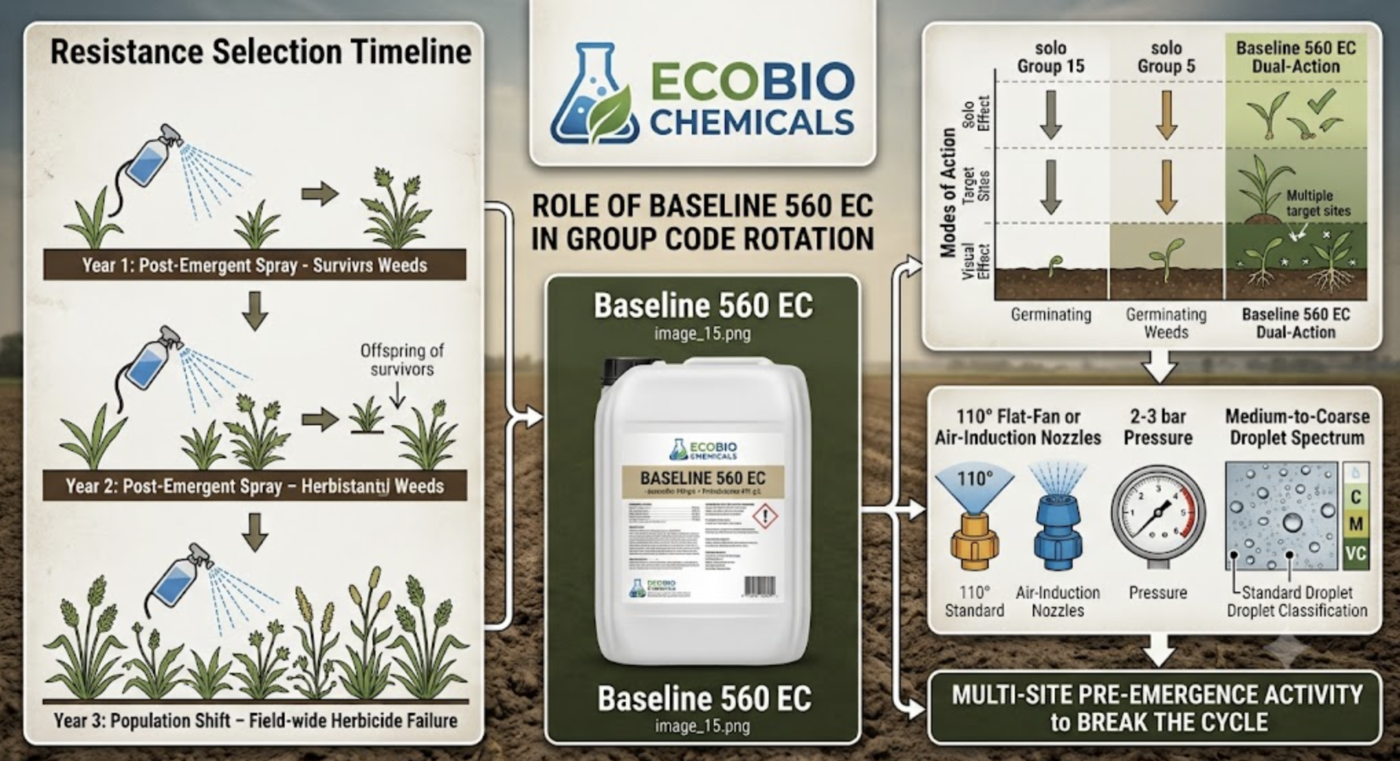
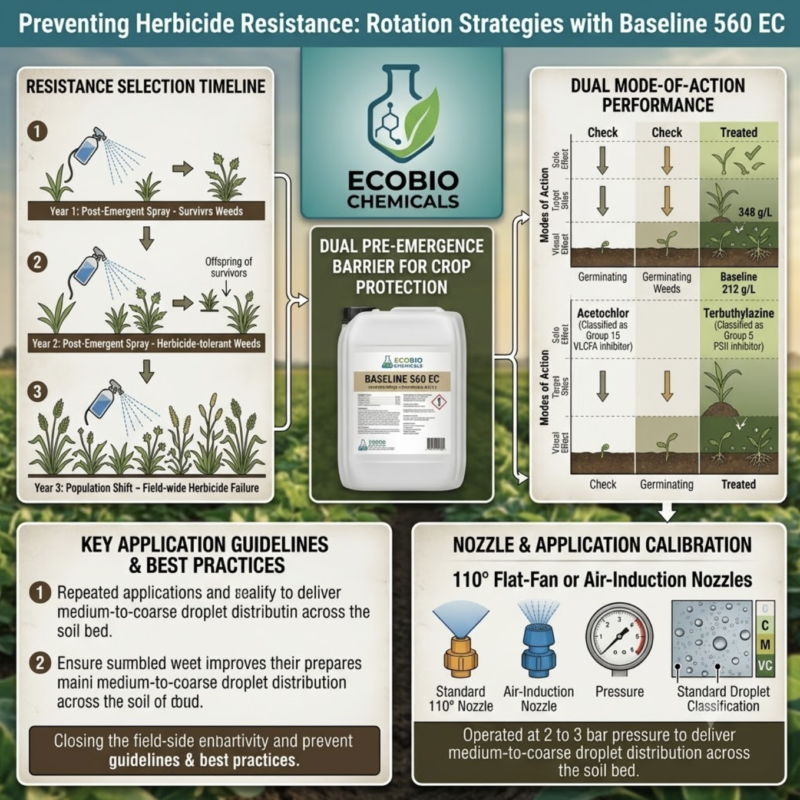
                      Resistance Selection Timeline
  ┌─────────────────────────────────────────────────────────────────────────────┐
  │                                                                             │
  │ Year 1: Single Mode of Action Applied ──► Rare resistant biotypes survive   │
  │ Year 2: Same Chemistry Applied ───────► Resistant weeds set seed & spread   │
  │ Year 3: Population Shift ─────────────► Field-wide herbicide failure       │
  │                                                                             │
  └─────────────────────────────────────────────────────────────────────────────┘
Effective herbicide resistance management requires combining modes of action, rotating herbicide groups, and using soil-residual pre-emergence barriers to suppress weeds before they emerge and produce seed.
The Role of Baseline 560 EC in Group Code Rotation
Baseline 560 EC is engineered to combat resistance by combining two distinct group code herbicides with complementary modes of action:
- Acetochlor (348 g/L): Classified as a Group 15 (formerly Group N) Very Long Chain Fatty Acid (VLCFA) inhibitor. It targets germinating shoots and roots by inhibiting cell division.
- Terbuthylazine (212 g/L): Classified as a Group 5 (formerly Group C1) Photosystem II (PSII) inhibitor. It blocks photosynthesis via root absorption in germinating broadleaf weeds.
Using a dual-mechanism pre-emergence herbicide significantly lowers the statistical probability of target-site mutation, as a weed seedling must possess simultaneous resistance mechanisms to survive both active ingredients.
Technical Specifications and Rotation Matrix
To maintain long-term field efficacy, Baseline 560 EC should be rotated across seasons with alternative herbicide group codes.
Chemical Specification Breakdown
| Parameter | Specification Details |
| Active Ingredients | Acetochlor (348 g/L) + Terbuthylazine (212 g/L) |
| Formulation Type | Emulsifiable Concentrate (EC) |
| HRAC Group Classification | Group 15 + Group 5 |
| Application Timing | Pre-emergence (Planting to pre-crop emergence) |
| Application Equipment | Boom sprayer using standard 110°C flat-fan or air-induction nozzles |
| Spraying Parameters | 2-3 bar pressure delivering a medium-to-coarse droplet spectrum |
Seasonal Group Code Rotation Program
| Rotation Phase | Dominant Crop | Target Weed Spectrum | Primary Herbicide Group Codes | Role in Resistance Plan |
| Season 1 | Maize / Corn | Grasses & Broadleaves | Baseline 560 EC (Group 15 + Group 5) | Dual pre-emergence soil barrier |
| Season 2 | Soybeans | Broadleaf escapes | Group 14 (PPO Inhibitors) or Group 3 | Alternate active site; target broadleaves |
| Season 3 | Sunflowers / Legumes | Annual grasses | Group 15 solo + Group 2 post-emergence | Target-specific suppression |
Key Agronomic Best Practices for Resistance Prevention
Integrating chemical controls into a broader Integrated Weed Management (IWM) system maximizes product performance and prolongs chemical longevity:
- Calibrate Sprayer Equipment: Apply Baseline 560 EC using standard 110°C flat-fan or air-induction nozzles operated at 2 to 3 bar pressure to deliver a medium-to-coarse droplet spectrum across the soil bed.
- Never Use Sub-Lethal Rates: Always adhere to recommended dosage rates based on soil clay percentage. Applying reduced rates exposes weed seedlings to sub-lethal doses, accelerating metabolic resistance.
- Incorporate Mechanical & Cultural Practices: Combine chemical treatments with certified clean seed, shallow inter-row cultivation where appropriate, and competitive crop canopy closure.