
Baseline 560 EC
Understanding Glyphosate Alternatives: Baseline 560 EC
Aug
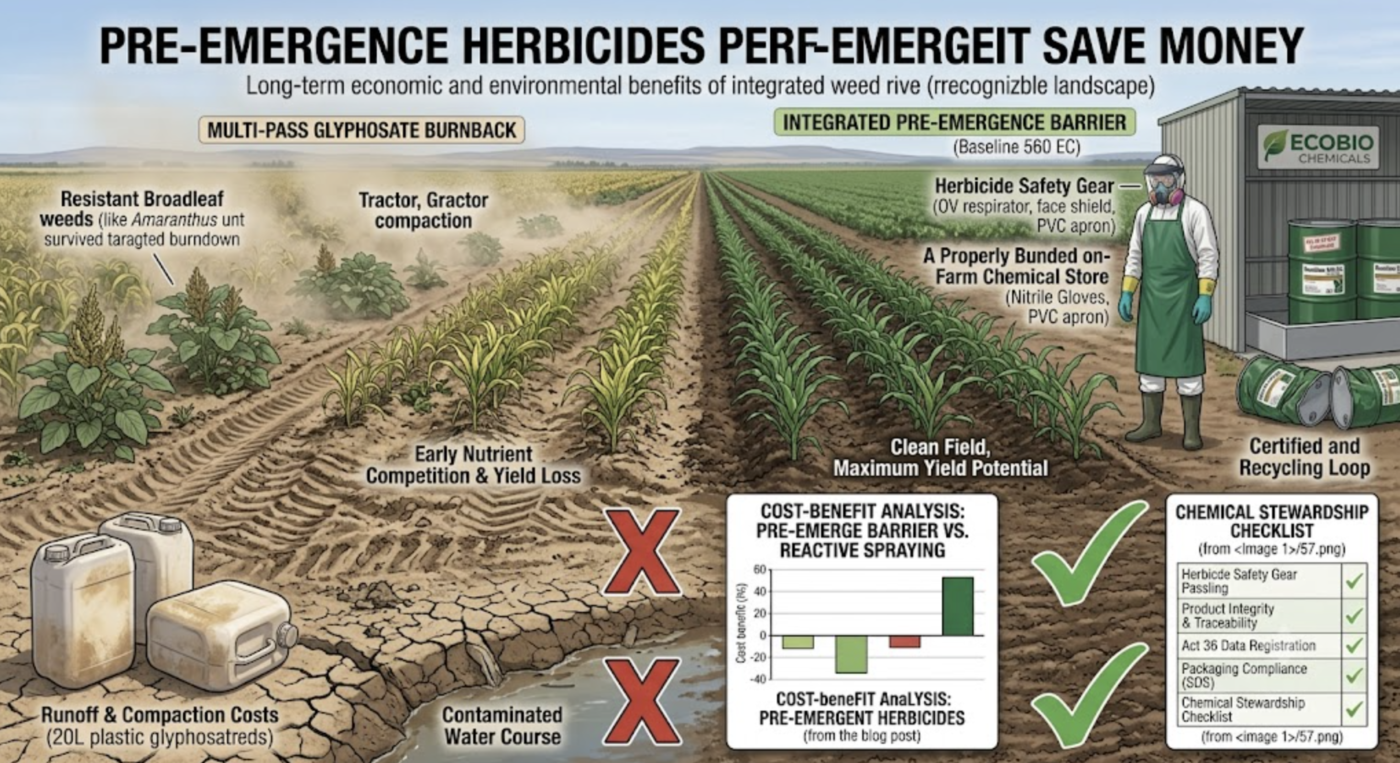
Baseline 560 EC : Why Pre-Emergent Herbicides Save Money
For decades, non-selective post-emergence broad-spectrum burndown herbicides like glyphosate served as the primary tool for seasonal weed control. However, widespread reliance on post-emergence burnback applications has accelerated glyphosate resistance in broadleaf weeds and annual grasses.
Relying exclusively on knockdowns creates compounding financial losses through multiple spray passes, higher application volumes, and severe yield loss from early weed competition. Incorporating selective residual treatments like Baseline 560 EC (Acetochlor 348 g/L + Terbuthylazine 212 g/L) provides a proactive approach that reduces overall chemical spend while protecting crop potential.
The Economic Realities of Pre-Emergence vs. Post-Emergence
Pre-emergence herbicides act as a chemical barrier in the top layer of soil, terminating weed seeds as they germinate before they can draw moisture, nitrogen, and sunlight away from emerging crops.
                       ROI & Herbicide Pass Comparison
  ┌─────────────────────────────────────────────────────────────────────────────┐
  │                                                                             │
  │ REACTIVE (Post-Emergence Burndown Only)                                      │
  │ ──► Multiple Glyphosate Passes ──► Fuel + Labor + Yield Loss (Weed Drag)   │
  │                                                                             │
  │ PROACTIVE (Pre-Emergence Residual Barrier)                                  │
  │ ──► Single Pre-Plant EC Application ──► Clean Canopy + High ROI Protection   │
  │                                                                             │
  └─────────────────────────────────────────────────────────────────────────────┘
When comparing total operational costs across a full growing season, residual pre-emergence barriers deliver distinct financial advantages:
- Elimination of Early Weed Competition: Crop yields are established during the first 3 to 6 weeks after germination. Weeds emerging alongside seedlings cause irreversible yield drag within days. A single pre-emergence pass maintains a clean seedbed during this critical window.
- Fewer Field Passes: Spraying multiple post-emergence burndowns increases diesel fuel consumption, operator labor hours, tractor wear, and soil compaction.
- Breaking Resistance Pathways: Tank-mixing dual active ingredients (such as Acetochlor and Terbuthylazine) targets different sites of action, preventing resistant weed seedbanks from multiplying across crop cycles.
Cost-Benefit Analysis: Pre-Emergent Barrier vs. Reactive Spraying
| Operational Factor | Multi-Pass Post-Emergence Program | Integrated Pre-Emergence Program (Baseline 560 EC) |
| Pass Frequency | 3-4 sprays per season | 1 pre-emergence pass (+ optional spot touch-up) |
| Active Weed Competition | High (Weeds absorb nutrients before spray application) | Minimal (Weeds terminated at germination) |
| Fuel & Equipment Wear | High (3-4 x field hours, engine wear, tire soil compaction) | Low (Single application tied to seedbed preparation) |
| Resistance Management | Poor (High risk of single-site active resistance) | Superior (Dual active ingredients disrupt resistance) |
| Yield Potential Retained | 80%-90% (Due to early-season nutrient theft) | 95%-100% (Uninhibited early crop canopy growth) |
Storage & Environmental Stewardship for EC Formulations
Maximizing the economic return of high-potency emulsifiable concentrate (EC) herbicides requires maintaining strict compliance with national chemical storage regulations, enforcing protocols for the safe disposal of pesticide containers, and taking steps aimed at preventing runoff.
                   Compliant Agrochemical Safety Framework
  ┌─────────────────────────────────────────────────────────────────────────────┐
  │                                                                             │
  │  [✓] SANS 10206 Store (110% Capacity Concrete Bund Retaining Wall)          │
  │  [✓] Mandatory Triple-Rinse Procedure (Rinsate Poured into Spray Tank)       │
  │  [✓] Certified Container Recycling (Punctured Base / CropLife SA)           │
  │  [✓] Required PPE (OV Respirator, Nitrile Gauntlets, PVC Apron & Goggles)   │
  │                                                                             │
  └─────────────────────────────────────────────────────────────────────────────┘
- Storage Compliance: Store commercial chemical containers in locked, cross-ventilated facilities featuring an impervious concrete floor surrounded by a 200 mm bund wall capable of holding 110% of total liquid volume under SANS 10206 standards.
- Environmental Protection: Prevent chemical leaching by maintaining vegetated buffer zones along water courses and avoiding spraying when heavy rain (>25 mm) or high winds (>15 km/h) are forecasted.
- Container Recycling: Never burn or bury chemical drums. Triple-rinse empty 20L or 5L containers, pour the rinsate back into the spray tank, puncture the container base, and send them to an accredited CropLife SA collector.
Safety Gear & Operator Protocols for EC Formulations
Because emulsifiable concentrates contain active ingredients dissolved in petroleum solvents, protective barriers are essential during measuring, mixing, and tank decontamination:
- Herbicide Safety Gear: Spray crews must wear 14 + mil chemical-resistant nitrile gauntlets, heavy PVC aprons, splash goggles, face shields, and half-mask respirators with Organic Vapor (OV) cartridges to guard against solvent fumes.
- Handling EC Formulations: Always measure concentrated liquid upwind of mixing equipment to avoid vapor inhalation and splash drift.
- Farm Worker Chemical Safety: Maintain emergency eyewash units and clean-water decontamination stations at all mixing locations, ensuring operators follow proper step-by-step PPE removal sequences.