
Baseline 560 EC
Baseline 560 EC: Summer Rainfall Region Crop Protections
Aug
Baseline 560 EC – A Seasonal Guide to Weed Management
In the summer rainfall regions of South Africa spanning the Highveld, Free State, North West, and parts of KwaZulu-Natal crop production relies heavily on the arrival of seasonal rains between October and March. While these rainfall patterns fuel rapid crop growth for staple crops like maize, soybeans, groundnuts, and sunflowers, they also create ideal conditions for explosive weed emergence.
Managing aggressive annual broadleaf weeds and grasses requires a disciplined approach using Baseline 560 EC. Aligning your South African crop protection calendar with effective soil-applied chemistries like Baseline 560 EC (Acetochlor 348 g/L + Terbuthylazine 212g/L) ensures that your fields remain clean, retaining critical soil moisture and seedbed nutrients during early crop development.
The Seasonal Crop Protection Calendar
Successful summer rainfall region farming depends on executing chemical interventions in synchronization with soil moisture and crop growth stages.
                  Summer Rainfall Weed Control Timeline
  ┌─────────────────────────────────────────────────────────────────────────────┐
  │                                                                             │
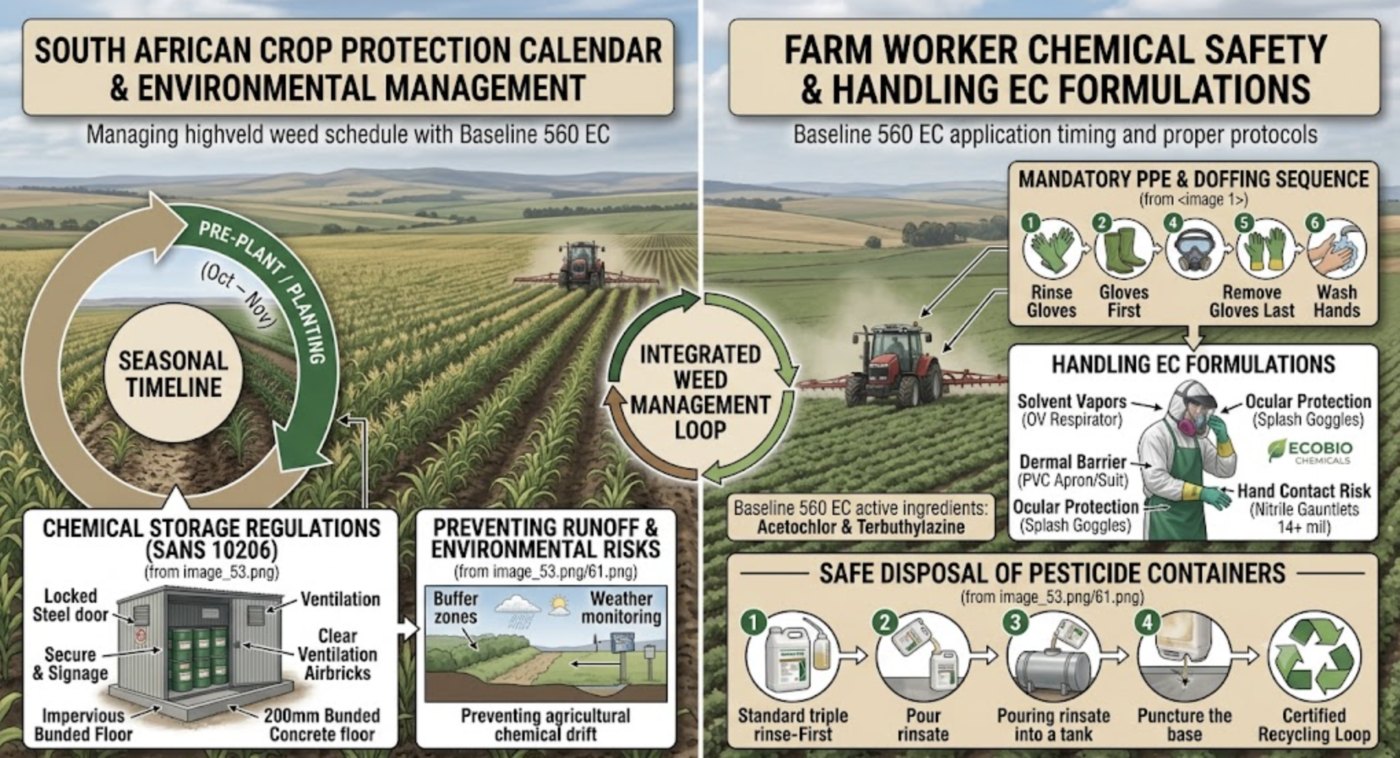
  │  PRE-PLANT / PLANTING (Oct – Nov)  ──► Apply Baseline 560 EC Pre-Emergence  │
  │  EARLY POST-EMERGENCE (Dec)        ──► Scout & Apply Targeted Post-Sprays    │
  │  MID-TO-LATE SEASON (Jan – Feb)    ──► Canopy Closure / Minimal Passes      │
  │  POST-HARVEST (Mar – Apr)          ──► Chemical Store Audit & Maintenance   │
  │                                                                             │
  └─────────────────────────────────────────────────────────────────────────────┘
1. Pre-Planting to Planting Window (October – November)
The first significant summer rains trigger both crop germination and the emergence of dormant weed seedbanks. Applying a broad-spectrum pre-emergence treatment like Baseline 560 EC directly onto moist soil at or immediately after planting forms a continuous chemical barrier in the top soil layer. This terminates weed seedlings as they germinate, giving cash crops a critical 4-to-6-week head start without weed competition.
2. Early Post-Emergence & Canopy Closure (December)
Scout fields regularly for any late-emerging or escape weeds. Spot-apply selective post-emergence treatments before the crop canopy closes. Once the canopy fully covers the inter-row spaces, natural shading prevents light from reaching the soil surface, suppressing late-season weed flushes naturally.
3. Post-Harvest Field & Store Management (March – April)
After harvest, focus shifts to farm sanitation, equipment decontamination, and auditing farm chemical inventories ahead of winter storage.
Seasonal Strategy Comparison: Pre-Emergent vs. Reactive Control
| Season Phase | Focus Activity | Strategic Objective | Risk of Delay |
| Early Summer (Oct–Nov) | Pre-emergence soil barrier (Baseline 560 EC) | Prevent early-season weed-crop competition for moisture and nitrogen. | Severe yield drag (15%-30% loss) within the first 21 days. |
| Mid-Summer (Dec–Jan) | Scouting & targeted post-emergence touch-ups | Control escapes and prevent seedbank replenishment. | Weeds set seed, increasing seedbank pressure for the following season. |
| Late Summer (Feb–Mar) | Mechanical / chemical border maintenance | Block weed encroachment from field margins and fence lines. | Infiltration of hard-to-control perennial weeds into arable land. |
Chemical Storage & Environmental Protection Standards
High-potency emulsifiable concentrate (EC) herbicides require responsible management to comply with national chemical storage regulations, enforce the safe disposal of pesticide containers, and take proactive steps toward preventing runoff into natural water systems.
                    Compliant On-Farm Chemical Management
  ┌─────────────────────────────────────────────────────────────────────────────┐
  │                                                                             │
  │  [✓] SANS 10206 Store (110% Capacity Concrete Bund Retaining Wall)          │
  │  [✓] Mandatory Triple-Rinse Procedure (Rinsate Poured into Spray Tank)       │
  │  [✓] Certified Recycling (Punctured Base / CropLife SA Accredited Collector) │
  │  [✓] Complete PPE (OV Respirator, Nitrile Gauntlets, PVC Apron & Goggles)   │
  │                                                                             │
  └─────────────────────────────────────────────────────────────────────────────┘
- Storage Compliance (SANS 10206): Store chemicals in a lockable, cross-ventilated facility with a non-porous concrete floor and a 200 mm bund wall capable of holding 110% of the largest stored liquid volume.
- Environmental Safeguards: Avoid spraying ahead of heavy, torrential summer downpours (>25mm) that could cause chemical wash-off and groundwater leaching. Maintain vegetated filter strips around farm dams and streams.
- Container Disposal: Empty 20L and 5L drums must be triple-rinsed immediately after emptying. Pour the rinsate directly into the spray tank, puncture the container base to prevent re-use for food or water, and send the plastic to an accredited CropLife SA collector.
Essential Safety Protocols for Handling EC Formulations
Because EC formulations contain active ingredients dissolved in petroleum-based solvents, personal protection is mandatory during handling, mixing, and sprayer washing:
- Herbicide Safety Gear: Operators must wear chemical-resistant nitrile gauntlets (14 + mil), a heavy PVC apron, chemical splash goggles, and a half-mask respirator equipped with Organic Vapor (OV) cartridges.
- Handling EC Formulations: Always measure and pour concentrates upwind of the spray tank hopper to avoid inhaling solvent vapors or experiencing splash drift.
- Farm Worker Chemical Safety: Maintain an active emergency decontamination station with clean water and soap near all mixing points. Ensure workers follow a strict PPE removal sequence rinsing gloves first and removing them last – to avoid skin contamination.