
Baseline 560 EC
Baseline 560 EC: Safe Storage and Environmental Management of Agricultural Herbicides
Aug
Baseline 560 EC: Safe Storage and Environmental Management. Modern agricultural crop protection relies heavily on concentrated chemical solutions to protect yields and suppress weed competition. However, the management of pre-emergence treatments like Baseline 560 EC (Acetochlor 348 g/L + Terbuthylazine 212 g/L) does not end once spray passes are complete.
Emulsifiable Concentrate (EC) formulations require strict adherence to national chemical storage regulations, proper protocols for the safe disposal of pesticide containers, and active field practices aimed at preventing runoff. Implementing an integrated chemical stewardship strategy safeguards surrounding ecosystems, prevents groundwater contamination, and ensures compliance with South African National Standards (SANS 10206).
National Regulations for On-Farm Chemical Storage
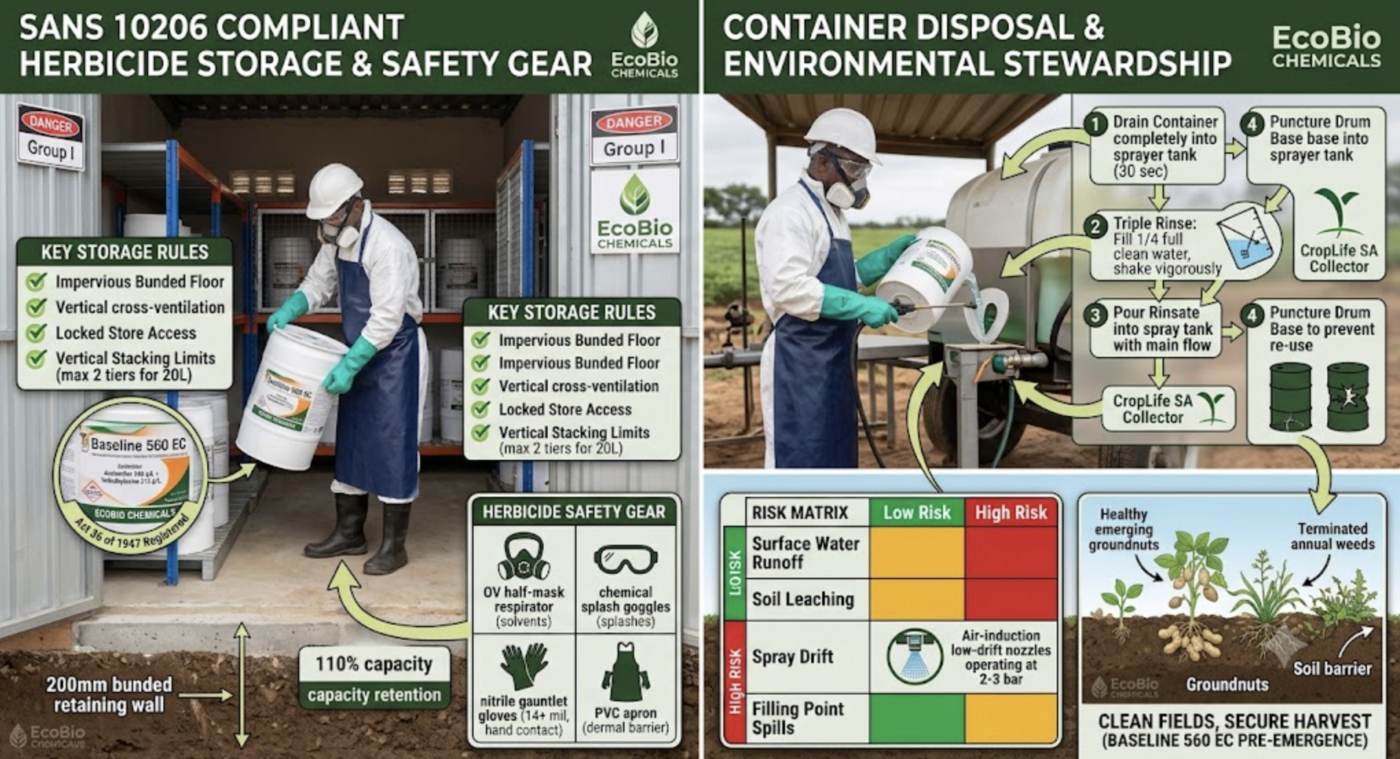
Storing commercial agrochemicals on-farm requires physical structures designed to contain spills, withstand fire hazards, and prevent unauthorized access. Under SANS 10206 guidelines, an approved chemical store must meet strict structural criteria:
                     Compliant On-Farm Agrochemical Store
  ┌─────────────────────────────────────────────────────────────────────────────┐
  │                                                                             │
  │  [✓] Impervious Concrete Floor with 200mm Bunded Retaining Wall             │
  │  [✓] Cross-Ventilation (Airbricks with Non-Corrodible Mesh)                 │
  │  [✓] Lockable Steel Access Doors & Separate Danger Group I Enclosures        │
  │  [✓] Dry Pallet Elevation (No Containers Direct on Cement Floors)           │
  │                                                                             │
  └─────────────────────────────────────────────────────────────────────────────┘
- Bunded Capacity: The facility floor must feature smooth, non-porous concrete surrounded by a watertight 200 mm bund wall. This bund must retain a minimum of 110% of the volume of the largest stored chemical container.
- Distance from Water Bodies: Chemical storage structures must be located well away from natural water courses, boreholes, and dams to eliminate leaching risks.
- Vertical Stacking Rules: Store liquid EC chemicals below powder or dry granular formulations to prevent liquid leaks from damaging dry packaging underneath. Plastic or metal drums of 20L capacity or greater must never be stacked more than two tiers high.
Triple Rinsing & Safe Container Disposal Protocols- Baseline 560 EC
Empty pesticide drums are classified as hazardous waste until they undergo verified decontamination. Under national environmental waste legislation, burning or burying empty plastic containers on farm property is illegal and subject to severe penalties.
                     Container Decontamination Workflow
  ┌─────────────────────────────────────────────────────────────────────────────┐
  │                                                                             │
  │  Drain Container Completely ──► Triple Rinse (Quarter-Full Clean Water)     │
  │                                                    │                        │
  │                                                    ▼                        │
  │  Recycling / Certified Disposal ◄── Puncture Drum Base ◄── Pour Rinsate into│
  │   (CropLife SA Collector)         (Prevent Re-use)         Spray Tank       │
  │                                                                             │
  └─────────────────────────────────────────────────────────────────────────────┘
The Standard Triple-Rinse Procedure
- Drain: Allow the container to drain completely into the sprayer tank for at least 30 seconds after the main flow has slowed to a drip.
- Rinse: Fill the container 1/4 full with clean water. Replace the cap securely and shake or roll the container vigorously for 30 seconds.
- Pour: Pour the rinsate directly back into the spray tank as part of your total water volume.
- Repeat: Repeat this process two additional times (for a total of three rinses).
- Render Unusable: Puncture the bottom of the container and crush it so it cannot be re-used for water or food storage. Send nominally empty containers to a certified CropLife SA accredited plastics recycler.
Preventing Environmental Runoff & Off-Target Drift
Active ingredients in pre-emergence herbicides can move off-target via surface runoff or spray drift if applied under poor meteorological or soil conditions.
| Risk Factor | Trigger Condition | Mitigation Strategy |
| Surface Water Runoff | Heavy rainfall event (>25mm) imminent within 24 hours | Postpone spraying until soil moisture stabilizes; maintain vegetated buffer strips along waterways. |
| Soil Leaching | Coarse, sandy soils with <10% clay content | Reduce application rates or select alternative chemistries to protect shallow groundwater aquifers. |
| Spray Drift | Wind speeds exceeding 15 km/h or temperature inversions | Use air-induction low-drift nozzles operating at 2-3 bar to generate coarse droplet spectrums. |
| Filling Point Spills | Uncontained mixing near farm boreholes | Use bunded, non-porous filling platforms equipped with stone-filled evaporation sumps. |
Mandatory Personal Safety Equipment
Farm operators handling concentrated emulsifiable herbicides during storage inventory or container disposal must maintain full protective barriers:
- Respiratory Care: Half-mask respirator fitted with Organic Vapor (OV) cartridges to handle solvent fumes.
- Dermal Protection: Heavy-duty 14 + mil nitrile gauntlet gloves and chemical-resistant PVC aprons.
- Eye Protection: Enclosed chemical splash goggles or full-face shields.