
Herbicides, Baseline 560 EC
Integrated Weed Management (IWM): Combining Mechanical and Chemical Controls
Aug
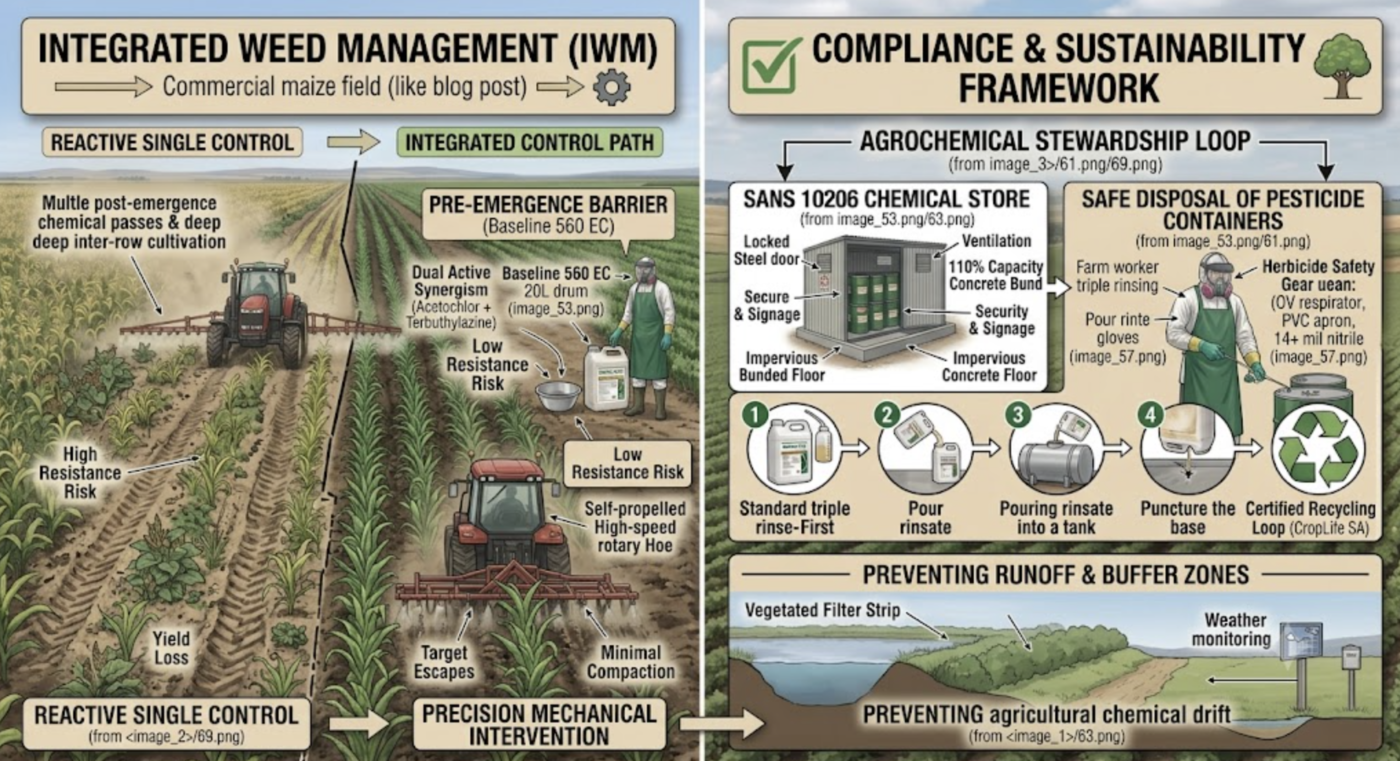
Integrated Weed Management (IWM) provides a holistic approach that combines physical, cultural, and chemical controls to suppress weed seedbanks while maintaining high crop yields. As agricultural input costs rise and herbicide-resistant weed populations expand across South African production regions, relying on a single weed control method is no longer viable.
Adopting sustainable farming practices South Africa wide allows broadacre producers to protect long-term soil health and maximize operational efficiency. Combining soil-applied pre-emergence chemistries like Baseline 560 EC (Acetochlor 348 g/L + Terbuthylazine 212 g/L) with precision mechanical interventions creates a resilient weed management framework that guards against resistance buildup.
The Core Pillars of Integrated Weed Management
IWM does not eliminate chemical usage; instead, it optimizes chemical applications by pairing them with mechanical tillage, crop rotation, cover crops, and field sanitation.
                  The 4 Pillars of Integrated Weed Management
  ┌─────────────────────────────────────────────────────────────────────────────┐
  │                                                                             │
  │  1. CHEMICAL CONTROL    ──► Residual Pre-Emergent Soil Barrier              │
  │                             (Baseline 560 EC)                               │
  │  2. MECHANICAL CONTROL  ──► Inter-Row Cultivation & Shallow Tillage         │
  │  3. CULTURAL CONTROL    ──► Crop Rotation, Narrow Row Spacing & Cover Crops │
  │  4. SANITATION & SAFETY ──► Store Compliance, Buffer Zones & Safe Disposal  │
  │                                                                             │
  └─────────────────────────────────────────────────────────────────────────────┘
1. Chemical Residual Foundation
Applying a broad-spectrum pre-emergence herbicide like Baseline 560 EC at or immediately after planting establishes an early, weed-free zone during the critical first 30 days of crop growth. The dual-action combination of Acetochlor and Terbuthylazine stops germinating broadleaf weeds and grasses before they emerge and compete for nutrients.
2. Strategic Mechanical Interventions
Inter-row cultivation, high-speed rotary hoes, or shallow surface tillage target weed escapes that survive chemical passes or emerge after chemical barriers weaken. Executing mechanical passes while weeds are in the white-thread to 2-leaf stage prevents them from establishing deep taproots or setting seeds.
Comparing Standalone vs. Integrated Weed Control
| Strategy | Primary Mechanism | Resistance Risk | Environmental & Soil Impact | Long-Term Cost Efficiency |
| Chemical-Only | Multiple post-emergence herbicide passes | High risk of weed resistance | Potential chemical buildup & runoff | High (increasing spray passes required over time) |
| Mechanical-Only | Frequent tractor tillage & inter-row cultivation | Zero chemical resistance risk | Risk of soil compaction, erosion & moisture loss | High (fuel, labor, and machinery wear) |
| Integrated Approach (IWM) | Baseline 560 EC + targeted inter-row cultivation | Low risk (dual actives + physical removal) | Preserves soil structure & minimizes environmental impact | High (optimized chemical usage + protected yields) |
Best Practices for Combining Mechanical and Chemical Tools
- Respect the Chemical Barrier: Avoid shallow tillage or inter-row cultivation immediately after applying pre-emergence herbicides like Baseline 560 EC. Disruption tears the uniform soil layer, allowing dormant weed seeds to reach the surface and germinate.
- Timing Inter-Row Tillage: Reserve mechanical passes for mid-season control (3-5 weeks post-planting) when the pre-emergence barrier begins to naturally dissipate and before full canopy closure occurs.
- Combine with Cultural Practices: Use narrow row spacing and optimized planting densities to encourage rapid canopy closure, using natural shading to suppress late-season weed flushes.
Agrochemical Storage, Environmental Safety & Compliance
Executing a successful IWM program requires responsible handling of emulsifiable concentrate (EC) herbicides, maintaining full compliance with chemical storage regulations, enforcing protocols for the safe disposal of pesticide containers, and taking active measures for preventing runoff.
                   Compliant Agrochemical Stewardship Loop
  ┌─────────────────────────────────────────────────────────────────────────────┐
  │                                                                             │
  │  [✓] SANS 10206 Store (110% Capacity Concrete Bund Retaining Wall)          │
  │  [✓] Complete PPE (OV Respirator, Nitrile Gauntlets, PVC Apron & Goggles)   │
  │  [✓] Environmental Safety (Vegetated Buffer Strips & Spray Weather Checks) │
  │  [✓] Certified Recycling (Triple-Rinse, Puncture Drum & Route to CropLife)  │
  │                                                                             │
  └─────────────────────────────────────────────────────────────────────────────┘
- Storage Compliance (SANS 10206): Store herbicides in a lockable, cross-ventilated facility equipped with a non-porous concrete floor and a 200 mm bund wall capable of retaining 110% of total liquid volume.
- Herbicide Safety Gear: Operators handling EC formulations must wear chemical-resistant $14 +mil nitrile gauntlet gloves, heavy PVC aprons, chemical splash goggles, and half-mask respirators with Organic Vapor (OV) cartridges to ensure complete farm worker chemical safety.
- Container Disposal & Runoff Mitigation: Triple-rinse empty 5L and 20L drums immediately after use, pour rinsate into the spray tank, puncture the base to prevent reuse, and send the plastic to an accredited CropLife SA collector. Maintain vegetated filter strips near dams and waterways to prevent chemical runoff during heavy summer rains.