
Uncategorized
Baseline 560 EC – Economic Impact of Early Weed Competition on Maize and Soybean Profitability
Aug
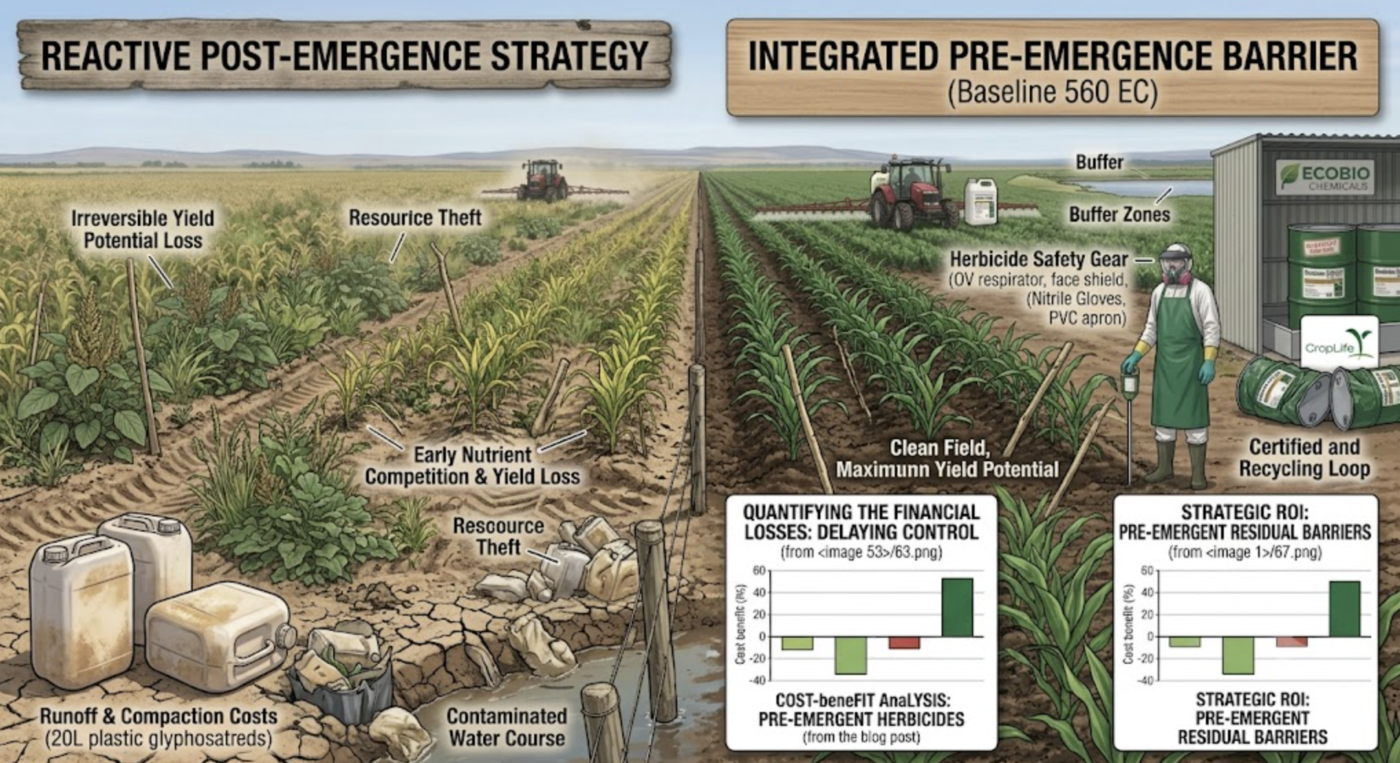
In row-crop operations, profit margins are decided long before harvest. While inputs like seed genetics, fertilizer, and irrigation dominate budgeting discussions, uncontrolled early-season weeds quietly erode gross margins. The cost of weed infestation in row crops goes far beyond the price of post-emergence chemical sprays it directly subtracts metric tons per hectare from final yield potential.
Understanding the timing and physiological mechanics of early weed competition allows broadacre producers to implement targeted crop yield protection strategies. Soil-applied pre-emergence chemistries like Baseline 560 EC (Acetochlor 348 g/L + Terbuthylazine 212 g/L) establish an early clean field environment, preventing competitive resource theft during critical crop establishment phases.
The Physiology of Early Resource Theft
During the first 3 to 6 weeks after germination known as the Critical Period of Weed Control (CPWC) maize and soybean crop plants determine their yield architecture. For maize, potential kernel rows and ear length are fixed early in plant development; for soybeans, early node density and branching potential are established during vegetative stages.
                  Critical Period of Weed Control (CPWC)
  ┌─────────────────────────────────────────────────────────────────────────────┐
  │                                                                             │
  │  VEGETATIVE STAGE (V1 – V6) ──► Early Weed Competition Occurs               │
  │                                             │                               │
  │                                             ▼                               │
  │    [ Loss of Nitrogen/Water ] ──► [ Irreversible Yield Potential Loss ]    │
  │                                             │                               │
  │                                             ▼                               │
  │  POST-EMERGENCE BURNDOWN APPLIED ──► Field Looks Clean, Yield Potential Lost │
  │                                                                             │
  └─────────────────────────────────────────────────────────────────────────────┘
When broadleaf and grass weeds emerge concurrently with the crop, they trigger two damaging mechanisms:
- Direct Nutrient and Water Deprivation: Fast-rooting weed species draw down plant-available nitrogen and soil moisture within the top root zone, stunting crop seedling vigor.
- Far-Red Light Signal Shift: Emerging crop leaves detect reflected far-red light from surrounding weed foliage. This shaded light spectrum triggers an immediate shade-avoidance response, causing the crop to allocate metabolic energy into stem elongation rather than root and leaf development.
Quantifying the Financial Losses: Delaying Control
Waiting until weeds reach 50-100 mm in height to apply a post-emergence burnback spray allows early competition to permanently reduce crop yields.
| Days Post-Emergence Without Control | Estimated Maize Yield Loss (%) | Estimated Soybean Yield Loss (%) | Financial Impact per 100 Ha (ZAR Equivalent) |
| 0–14 Days (Pre-Emergence Protected) | 0% | 0% | Full Target Yield Retained |
| 15–21 Days | 3%-7% | 2%-5% | Moderate Revenue Loss |
| 22–28 Days | 8%-15% | 6%-12% | Substantial Profit Reduction |
| 29+ Days | 16%-30% | 13%-25% | Severe Profit Margin Erosion |
Strategic ROI: Pre-Emergent Residual Barriers
Integrating Baseline 560 EC as a pre-emergence soil barrier at or immediately after planting eliminates weed seeds as they germinate, securing a completely clean canopy during the 30 day CPWC window.
- Dual Active Synergism: Acetochlor (a systemic root/shoot inhibitor) combined with Terbuthylazine (a photosynthesis inhibitor) targets multiple weed metabolic pathways, broadening the weed spectrum and preventing resistant seedbank buildup.
- Reduced Operational Costs: Eliminating early weed competition reduces the need for multiple, high-rate post-emergence pass applications, lowering seasonal diesel fuel consumption, operator hours, tractor wear, and soil compaction.
On-Farm Stewardship, Compliance & Safety Standards
Maximizing commercial returns from emulsifiable concentrate (EC) formulations requires maintaining strict adherence to chemical storage regulations, enforcing protocols for the safe disposal of pesticide containers, and active measures for preventing runoff.
                   Compliant Agrochemical Stewardship Loop
  ┌─────────────────────────────────────────────────────────────────────────────┐
  │                                                                             │
  │  [✓] Store Compliance (SANS 10206 - 110% Impervious Bunding)                │
  │  [✓] Personal Safety (OV Respirator, 14+ mil Nitrile, PVC Apron & Goggles)  │
  │  [✓] Environmental Safety (Maintain Grassed Buffer Strips & Water Checks)   │
  │  [✓] Certified Recycling (Triple-Rinse, Puncture Drum & Route to CropLife)  │
  │                                                                             │
  └─────────────────────────────────────────────────────────────────────────────┘
- Storage Compliance (SANS 10206): Store agricultural chemicals in dedicated, lockable facilities equipped with non-porous concrete floors and a 200 mm bund wall capable of holding $110\%$ of total stored liquid volume.
- Herbicide Safety Gear: Operators handling concentrated EC formulations must wear chemical-resistant 14 + mil nitrile gauntlets, heavy-duty PVC aprons, chemical splash goggles, and half-mask respirators with Organic Vapor (OV) cartridges to ensure complete farm worker chemical safety.
- Container Disposal & Runoff Mitigation: Triple-rinse empty 5L and 20L containers directly into the spray tank, puncture the base to prevent secondary re-use, and transfer them to an accredited CropLife SA recycling collector. Maintain vegetated filter zones along rivers and dams to prevent chemical run-off during intense summer storms.