
Baseline 560 EC
Cleaning After Using Baseline 560 EC and Proper Spray Equipment Maintenance
Aug
Thorough sprayer sanitation is critical when transitioning from broadacre pre-emergence treatments to sensitive post-emergence crop applications. Baseline 560 EC is an emulsifiable concentrate formulated with active ingredients Acetochlor (348 g/L) and Terbuthylazine (212 g/L) dissolved in petroleum-based solvents.
Because emulsifiable concentrates leave oily solvent residues along tank walls, pump diaphragms, and spray hoses, simple water flushes are insufficient. Learning how to clean agricultural sprayers systematically and executing complete tank decontamination protocols are essential for preventing cross-contamination in crops and extending equipment life.
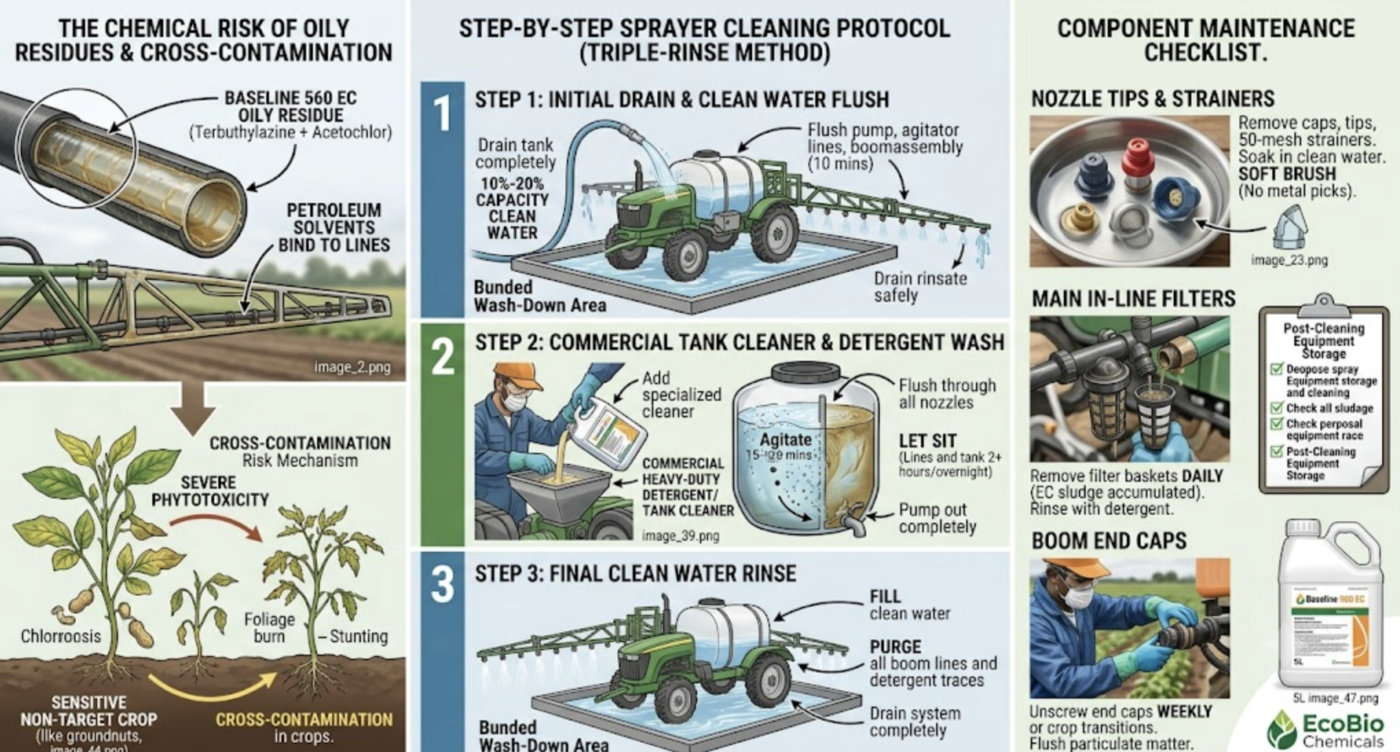
The Chemical Risk of Oily Residues & Cross-Contamination – Baseline 560 EC
When Baseline 560 EC sits in a spray tank, the solvent carriers bind to plastic lines, rubber hoses, and fiberglass surfaces. If a subsequent crop spray such as a broadleaf selective treatment or foliar fertilizer contains surfactants or oils, it will strip those bound residues from the tank walls.
                  Cross-Contamination Risk Mechanism
  ┌─────────────────────────────────────────────────────────────────────────────┐
  │                                                                             │
  │ Uncleaned Tank Walls ──► New Spray Pass + Surfactant ──► Strips Residual   │
  │ (Baseline 560 EC)                                        Actives            │
  │                                                             │               │
  │                                                             ▼               │
  │  Severe Phytotoxicity ◄── Direct Foliage Contact ◄── Unintended Application │
  │  & Crop Stunting            (Sensitive Crops)        (Contaminated Solution)│
  │                                                                             │
  └─────────────────────────────────────────────────────────────────────────────┘
Even micro-quantities of Terbuthylazine or Acetochlor applied to non-target, sensitive broadleaf crops (such as soybeans, dry beans, or sunflower seedlings) can cause severe chlorosis, foliage burn, and permanent yield loss.
Step-by-Step Sprayer Cleaning Protocol (Triple-Rinse Method)
Decontaminate your spray rig immediately after completing an application. Never allow Baseline 560 EC spray mixtures to dry inside the tank, pump, or boom lines.
Step 1: Initial Drain & Clean Water Flush
- Drain the spray tank completely in a designated, bunded wash-down area away from water sources.
- Fill the tank to at least 10%-20% capacity with clean, fresh water.
- Flush the water through the pump, agitator lines, manifold, and entire boom assembly for a minimum of 10 minutes, then drain completely.
Step 2: Commercial Tank Cleaner & Detergent Wash
- Refill the tank with clean water and add a specialized commercial heavy-duty detergent or tank-cleaning agent designed to break down oil-based EC solvent films (e.g., ammonia-based or specialized surfactant cleaners).
- Agitate and circulate the cleaning solution through the full system for 15 to 20 minutes.
- Open the boom lines and flush a portion of the solution through all nozzles.
- Shut off the pump and let the remaining solution sit in the lines and tank for at least 2 hours (or overnight for maximum solvent stripping).
- Pump out and drain the cleaning solution completely.
Step 3: Final Clean Water Rinse
- Fill the tank with clean water a third time.
- Flush the clean water through the entire boom network to ensure all detergent traces and loosened active residues are thoroughly purged.
- Drain the system completely.
Component Maintenance Checklist
Deep cleaning requires disassembling high-risk collection points where chemical residues lodge.
| Sprayer Component | Maintenance & Cleaning Action | Frequency |
| Nozzle Tips & Strainers | Remove nozzle caps, tips, and 50-mesh tip strainers. Soak in clean water with a soft brush (never use wire or metal picks). | After every application block |
| Main In-Line Filters | Remove filter baskets, scrape away accumulated EC sludge, and rinse with detergent water. | Daily during active spraying |
| Boom End Caps | Unscrew end caps on each boom section and flush clean water through to remove trapped particulate matter. | Weekly or during crop transitions |
| Pump Diaphragms & Valves | Inspect seals for solvent swelling or degradation caused by EC carrier oils. Re-grease or replace worn seals. | End-of-season / Periodic maintenance |
Equipment Inspection & Storage Best Practices
                       Post-Cleaning Equipment Storage
  ┌─────────────────────────────────────────────────────────────────────────────┐
  │                                                                             │
  │  [✓] Remove & Clean All Filter Baskets   [✓] Inspect Hoses for Softening    │
  │  [✓] Store Nozzle Tips in Clean Water    [✓] Flush System with RV Antifreeze │
  │      / Cleaner Solution                      (Before Winter Storage)        │
  │                                                                             │
  └─────────────────────────────────────────────────────────────────────────────┘
- Dispose of Rinsate Safely: Always discharge rinsate onto an approved bio-bed, a bunded evaporation pit, or back onto the previously treated field sector in accordance with local environmental regulations.
- Inspect Hoses for Swelling: The petroleum solvents in EC formulations can soften or degrade rubber hoses over time. Check for soft spots, cracking, or internal delamination.
- Dry Storage: Leave tank lids cracked open slightly after full decontamination to allow internal moisture to evaporate, preventing fungal growth and corrosion inside the tank.