Herbicides, Baseline 560 EC
Baseline 560 EC Troubleshooting Poor Herbicide Performance: Common Application Mistakes to Avoid
Aug
Baseline 560 EC Troubleshooting Poor Herbicide performance. Investing in premium pre-emergence chemistry like Baseline 560 EC (Acetochlor 348 g/L + Terbuthylazine 212 g/L) is one of the most effective ways to secure weed-free fields and protect crop yields during early development. However, even the highest-grade emulsifiable concentrate (EC) formulations can underperform if critical application parameters are overlooked.
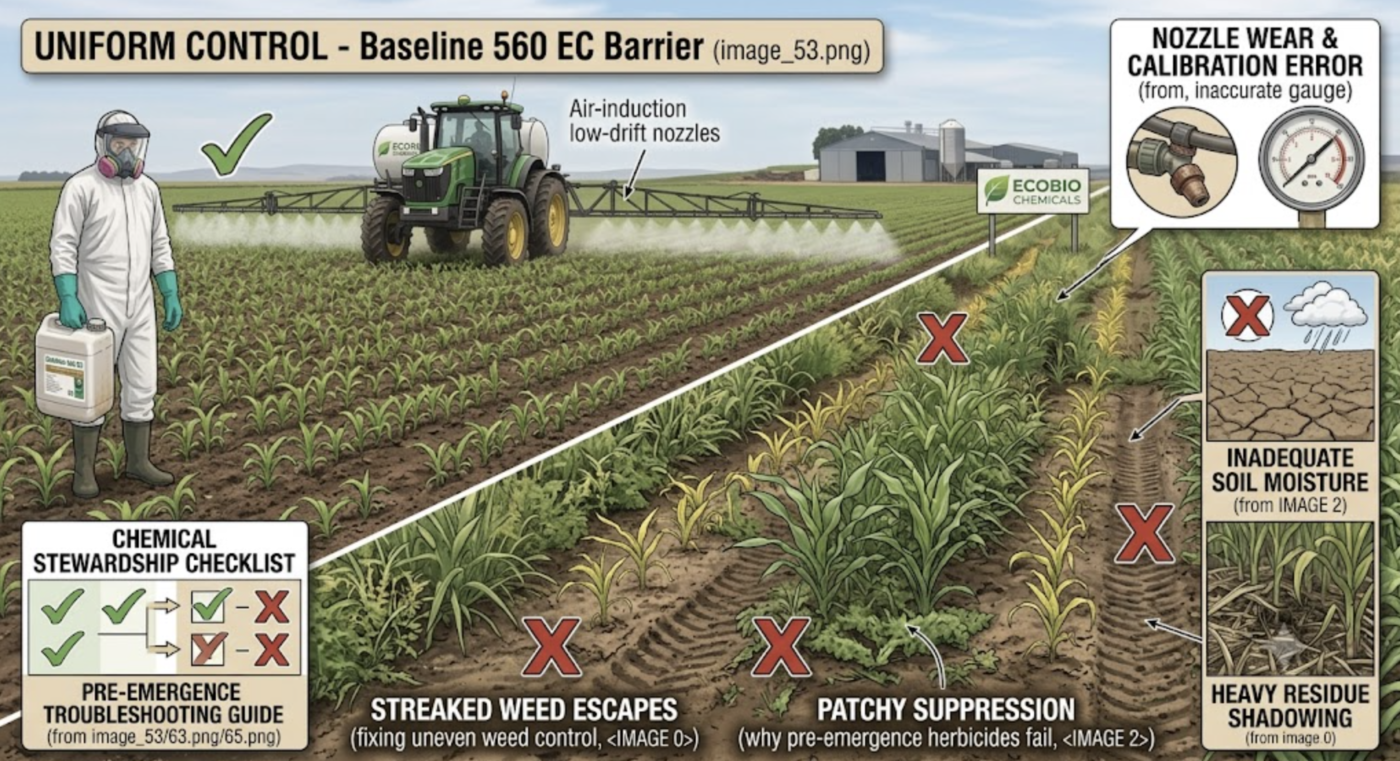
When growers experience patchy suppression or early weed escapes, the root cause is rarely product quality – it is almost always an application or environmental variable. Understanding why pre-emergence herbicides fail enables commercial operations to correct errors quickly, ensuring predictable weed control and a strong return on investment.
5 Primary Reasons Pre-Emergent Herbicides Underperform
Pre-emergence herbicides work by creating an uninterrupted chemical barrier in the top 20-30 mm of soil. Anything that breaks or thins this barrier creates pathways for emerging weed seedlings.
                  Causes of Soil Chemical Barrier Breakdown
  ┌─────────────────────────────────────────────────────────────────────────────┐
  │                                                                             │
  │  [!] Insufficient Soil Moisture (Herbicide Activation Failure)              │
  │  [!] Heavy Cloddy Seedbed / High Crop Residue (Uneven Coverage Streaks)      │
  │  [!] Incorrect Nozzle Selection & Boom Height (Spray Drift / Streaking)     │
  │  [!] Soil Binding (High Organic Matter or Clays Absorb Active Ingredients)   │
  │  [!] Excessive Mechanical Disturbance (Tillage Tears Chemical Layer)         │
  │                                                                             │
  └─────────────────────────────────────────────────────────────────────────────┘
1. Inadequate Soil Moisture for Activation
Soil-applied active ingredients require soil moisture to move into the top soil matrix where weed seeds germinate. In dry soils, the active molecules remain bound to soil particles and cannot be absorbed by the emerging weed roots and shoots.
- The Fix: Apply Baseline 560 EC into moist seedbeds, or time applications ahead of light rainfall (10-15 mm) or overhead irrigation.
2. Poor Seedbed Preparation & High Surface Residue
Cloddy, uneven seedbeds or heavy crop trash (such as un-mulched maize stover) create spray shadows. Seeds germinating under large soil clods or thick residue layers bypass the chemical barrier entirely.
- The Fix: Prepare a smooth, fine seedbed prior to application, or adjust water volume rates to ensure adequate soil penetration through trash.
3. Spray Boom Miscalibration & Nozzle Wear
Worn, clogged, or misaligned spray nozzles cause severe volumetric variations across the boom width, resulting in distinct bands of weed escapes alternating with over-application zones.
- The Fix: Calibrate spray booms regularly, check individual nozzle discharge rates, and replace worn tips. Use air-induction low-drift nozzles operated at 2-3 bar pressure.
Troubleshooting Guide: Diagnosing & Fixing Field Failures
| Field Symptom | Probable Root Cause | Corrective Action |
| Streaked Weed Escapes Across Rows | Boom height too low/high or worn/clogged nozzle tips | Calibrate boom height for 50%pattern overlap; flush and replace damaged nozzles. |
| Escapes in High-Residue Patches | Spray interception by un-managed crop trash | Increase water carrier volume (150-200 L/ha) to improve soil coverage. |
| Weeds Germinating Early Across Field | Applied to dry soil without activation rainfall | Apply light overhead irrigation (10-15 mm) to incorporate herbicide into seedbed. |
| Reduced Residual Persistence | Soil tillage after chemical application | Avoid mechanical cultivation after spraying to preserve the continuous soil barrier. |
Chemical Storage, Handling & Environmental Safety Standards – Baseline 560 EC Troubleshooting
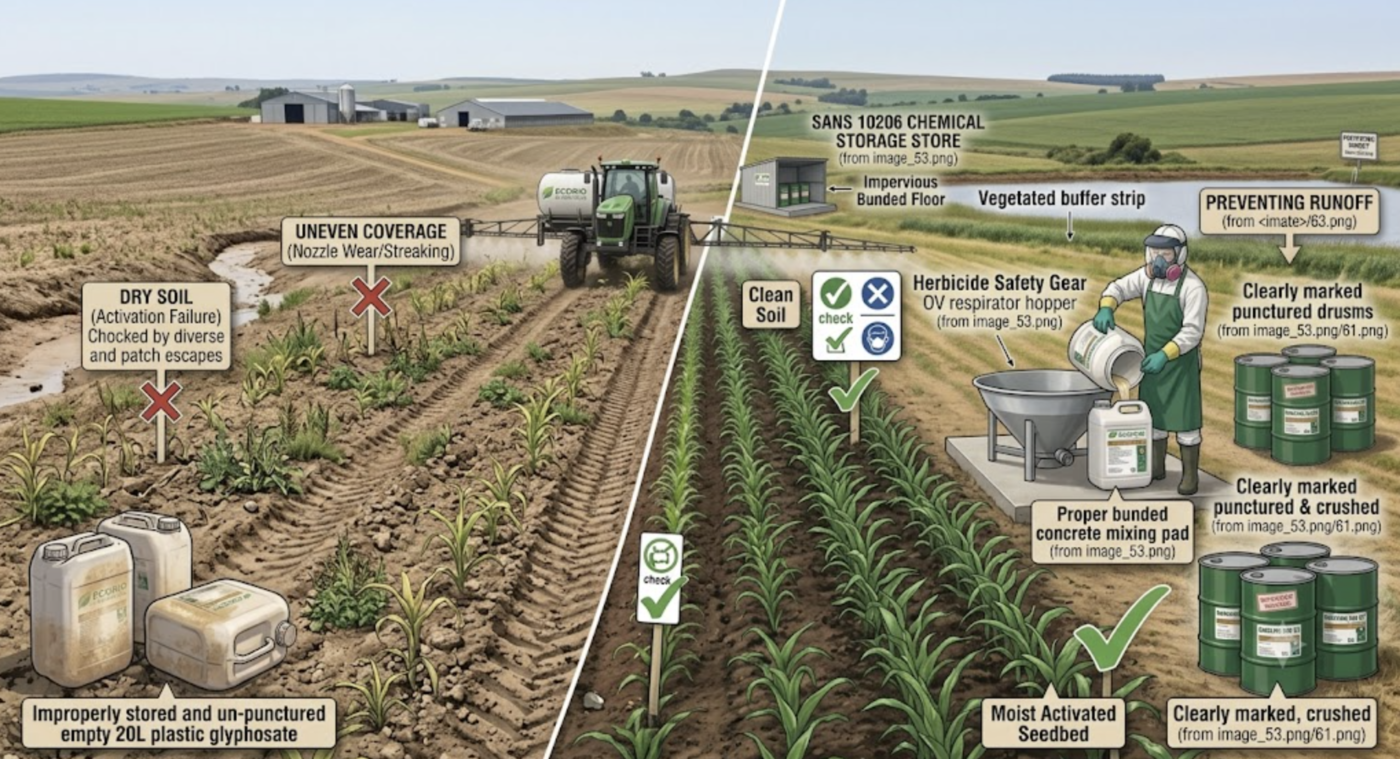
Achieving optimal herbicide performance goes hand-in-hand with strict farm safety, compliance with chemical storage regulations, enforcing the safe disposal of pesticide containers, and taking active measures for preventing runoff.
                   Compliant Agrochemical Safety Framework
  ┌─────────────────────────────────────────────────────────────────────────────┐
  │                                                                             │
  │  [✓] SANS 10206 Store (Impervious Concrete Floor with 200mm Bund Wall)      │
  │  [✓] Complete PPE (OV Half-Mask Respirator, 14+ mil Nitrile, PVC Apron)    │
  │  [✓] 3-Stage Triple-Rinse Protocol (Pour Rinsate Directly into Spray Tank)  │
  │  [✓] Certified Drum Disposal (Puncture Base & Send to CropLife Collector)    │
  │                                                                             │
  └─────────────────────────────────────────────────────────────────────────────┘
- On-Farm Chemical Storage (SANS 10206): Store Baseline 560 EC in a secure, well-ventilated, lockable facility equipped with a smooth, non-porous concrete floor and a 200 mm bund wall capable of retaining 110%of total liquid volume.
- Personal Protective Equipment: Handling concentrated EC formulations requires full herbicide safety gear, including chemical-resistant nitrile gauntlet gloves (14+ mil), a heavy PVC apron, chemical splash goggles, and a half-mask respirator fitted with Organic Vapor (OV) cartridges to guard against solvent fumes.
- Worker Safety & Container Disposal: Maintain active eyewash stations and clean wash-water facilities at all mixing locations to support overall farm worker chemical safety. After emptying containers, execute a thorough triple-rinse, pour the rinsate into the spray tank, puncture the drum base, and route the plastic to an accredited CropLife SA recycler.